These are my gut reactions to the XBox One press conference. Forgive me if I can’t predict the future.
People predict that this next console cycle will be the last of its kind due to the proliferation of alternative distribution methods like Steam and iOS, and that might be true with the advent of cloud computing. Outsourcing the number-crunching to powerful remote servers and having the console act only as a client for playing these games means that the only upgrades that need to be made are to those remote servers, nullifying the need to upgrade every few years. I’m excited.
Square box with sharp edges. Bleh.
That said, I can’t help but be incredibly disappointed at this morning’s XBox One reveal. Aside from its ugly design that would have been acceptable only in the early 2000s, the preoccupation with television other traditional forms of entertainment sets it up for failure. Fewer and fewer people are watching television and prefer to catch series through channels like iTunes, Youtube, and Netflix, formats that suit our increasingly busy lives and schedules. I mean, consider a number of my friends from film school, most of their goals don’t lie in theaters or TV screens, but in web series and internet video. To focus on traditional, centralized methods of media production sets us back. In essence, the XBox One is just trying to be an uglier DVR, while it is nice to have a centralized place to access all our entertainment options, I think we’re missing the point here.
Which brings us to games.
Aside from cloud computing’s power to advance the big-budget AAA games, it would seem that indies will be the deciding factor for who wins the so-called “console war”.
Let’s back up a bit, previous generations were never decided by console specs, they were decided by price and exclusives. Consider the Wii’s $250 launch price and the casual revolution that it started, and compare it to the PS3’s incredible processing power locked away behind system architecture so problematic that the 360 ended up consistently getting the best version of a multiplatform game. Point is, the complexity and power of a console isn’t going to make too much of a difference in how this console cycle plays out.
Furthermore, another change owes itself to the “Ludus Florentis” phenomenon that I pointed out in my previous post. Consumers are beginning to get tired of the big-budget AAA games, and instead of dropping $60 on a highly anticipated blockbuster, people are beginning to prefer to put that same money to purchase a variety of downloadable games, the success of Journey, Far Cry 3: Blood Dragon, and The Walking Dead prove this. Simply put, its not the console that has access to the most anticipated exclusives that will dominate this next generation, but the one that has the strongest indie-outreach program and online storefront.
Nintendo and Sony both recognized this change and made aggressive pushes to their plans for downloadable games. Sony made their massive indie kick by reformatting their storefront and adopting a familiar PC-like architecture for the PS4, as well as completely eliminating their developer registration fee. Nintendo made theirs by releasing the HTML5 based Nintendo Web Framework for the WiiU and opening up their submission process. As a result, the registration and development process for these consoles will be comparable to what already exists with Desura or the App Store, which can only mean good things for the diversity of games that will exist on these platforms. The XBox One’s preoccupation with the Call of Dutys and EA Sports of the world will probably make them increasingly irrelevant as the cycle plays out, which is disappointing, considering the wealth of great indie games like Bastion that owe their existence to XNA this generation.
Technology!
But more than anything else, what concerns me about this next generation are development costs. Both press conferences in the past few months marketed incredible graphical fidelity, pushing amazing texture resolution and ridiculous polycounts for each model in a game’s world.
This’ll mean bad things for games.
Art assets are one of the most time and resource consuming components of game development, already, asset production is outsourced to outside studios for many AAA games. Increasing the graphical fidelity of each asset in a 3D game world will only continue to bloat development costs and increase the level of damage done to a studio should a project fail.
Furthermore, games seem to market “emotional storytelling and characterization” with the graphical fidelity of these games. Strangely enough, “emotional” seems to have become a new buzzword in the odd era that we exist in at this moment.
But graphics don’t mean anything for emotional resonance.
The Walking Dead
Games are games, and achieve their meaning through play. The scarf-restoring cuddling and momentary escape from gravity connected to each jump in Journey made it such a compelling experience. The narrative weight lent to each dialogue option in the low-fi Walking Dead made one of the most emotionally intense games I’ve ever played. Graphical beauty didn’t make these games emotionally powerful, great ludic design did.
If anything, I’m intrigued by what this next console generation has to offer. Ludus Florentis opened up Steam, mobile, and cloud-based games to an unprecedentedly wide audience and diversified the kinds of games that could exist and succeed. The effects of what happened in these alternative spheres will mean a lot to how this next generation plays out.
This is a reflection about my first year at game school. Its long and reflective, deal with it.
I try not to have second thoughts about entering this industry. We’re riding the wave of Ludus Florentis, the massive sea change, maybe even movement, that James Portnow predicted three years ago, a term that I’ll refer to a lot in this article.
While as a player of games, I welcome the earthquake of creativity that is shaking up the industry right now, I remain concerned about what that could mean for my career. Right now, more people than ever are entering the game industry, and the old guards of yesterday can not possibly employ all that talent that’s flooding out of game schools. Independent developers like the ones I admire seldom look to hire or expand, and the few ones that do rarely seek applicants in design. As the bar to entry lowers, the bar to be competitive inches higher.
Chelsea Howe’s diagram of the factors that contribute to “Ludus Florentis”, a phrase that I’ll use here to describe what’s going on right now in gaming.
To be competitive in this world means to make necessary sacrifices, everyone is going to give up a little bit of themselves. I personally, ended my political outspokenness and stopped distance running, two facets of myself that I thought important to who I was. In retrospect, the former won’t be missed and the latter was mooted anyway by life in Los Angeles.
Nonetheless, anyone entering game school can expect to work harder than they ever have in their life. They must expect movement, and must be ready to relocate to get the necessary experience that would fulfill their goals. And challenge, those entering this industry must be ready to confront the stark reality of crunch time, demographic homogenity, limited compensation, family separation, the crossover of social and professional life, and a brief career likely lasting less than a decade.
But that’s barely an issue.
Maybe I’m being overly idealistic or something like it. To be part of this snapshot of time means that I’m part of a greater whole, and only with the combined creativity of game developers everywhere will we unlock a grand future. Being part of the microcosm of USC Games means that I am intrinsically part of this movement, and that the person I form myself to be in this moment in time will determine the direction of this movement and what the medium will become in the future.
What happened over the course of my first year at game school has sent me on a journey of my own (sorry), while I’m far from that designer that I want to be, I’ve already met strange new people from walks of life radically different from my own, I’ve traveled to the conventions and met the visionaries of the medium that I only dreamed of years ago, I’ve joined and worked on projects continually pushing the boundaries of what games could be and what they can do for the world.
And Things Got Strange.
By stepping into unknown territory, I opened myself to the risk of failure. But the finite nature of our existence, and the infinite nature of the unknown, moots success or failure in any professional domain. What really matters are our relationships to the people who are closest to us with whom we share our brief journey through this wilderness. ~ Jeff Watson
I worked on the next iteration of my 2012 game of the year, Reality Ends Here. A message went out that Jeff Watson was opening up an experimental class to design future iterations of the ARG, having received a grant to expand the game that had changed many a freshman’s life, connecting them to the friends they would paint the future with. I joined the team as a narrative designer, and was in charge of designing an overarching environmental narrative to create the atmosphere of subversive, self-motivated creativity that the future of entertainment demands from its practitioners.
A typical Reality Ends Here dev meeting.
Most of the details about what exactly we did to next year’s iteration of Reality Ends Here has to be kept under wraps, because, hey, spoilers, but I will say that working on it reminded me of the necessary constraints that time, manpower, and budget placed on these projects. When we began designing the narrative, we had this grand vision of an epic participatory story involving immersive theater, hundreds of audio-logs, story-rich spaces, fictional characters, and a simulated conflict. We ended up cutting out most of that content to only that which would maintain our laser focus on creating the desirable atmosphere of discovery and excitement that we want to provide to our players. Film school is a rabbit hole taking those who choose to explore it to strange lands of magic and adventure, we want to reinforce that aesthetic with this narrative.
I have great hope for Reality Ends Here. We made a huge number of fundamental changes to the game and expect to see the payoff in the quality of students that partake in this school. And given my knowledge of some of the plans we have for the game, Reality Ends Here may end up making some great difference in the world as a whole. Keep an eye out for us.
And Even Stranger.
Around the afternoon of March 28th, I received a phone call from my friend Esteban.
“Hey Kevin, wanna come up to GDC with us?”
“Uh, sure, I guess…”
“Great, meet us at New/North in an hour.”
So began an impromptu road trip.
We took the Highway 1 to San Francisco, the grand road running along the California coast. To our right lay rocky, grass-covered cliffsides hundreds of feet tall, to the right, the setting sun shimmered off the gold-tinted ocean, painting the sky an incredible orange-pink. A few hours later, we were in the grassy farmlands of the Central Valley, I reclined in my seat to look out the window, and saw stars brighter than anything I’ve ever seen.
I was born and raised in San Francisco, city lights and fog would drown out any sight of the night sky. To see hundreds of glittering specks in the sky and ponder the vastness of the universe was a strangely cathartic experience that I could never have in the city.
The road trip up to GDC, oddly moving.
I knew that GDC took place in San Francisco annually for several years by now, and as much as I wanted to go, even if only to meet people on the other side of development, restrictions caused by age and school would always prevent me from doing so, and frustratedly, I would watch the online coverage of the events and talks that were occurring only a few miles away. When I finally arrived to the crowded convention floor, I took a moment to take in the sights and sounds of the conference: hundreds of booths from every conceivable gaming company in the world, renowned visionaries like Ian Bogost, Robin Hunicke, and Keita Takahashi scuttled around the Moscone Center, and facial hair.
Sony made an incredible indie push at this year’s GDC.
And yet, something was different. An ecstatic energy pervaded the hundreds of developers at the conference, as if they were anticipating something huge to happen.
Evolution was in the air, everywhere you’d go, there were symptoms of the nascent renaissance. You’d see it in Chris Hecker’s wordless GDC rant, you’d see it at the crowdedness of this year’s Experimental Gameplay Workshop, you’d see it in the pervasive frustration over gender exclusivity at the major talks. Nowhere was this more obvious than at the GDC Awards, of the 14 available categories, only two were won by AAA games, and at the IGF, a poverty-simulator named Cart Life by Richard Hofmeier won Grand Prize. Being around for the Friday of the conference, I was surprised to see that the keynote speakers at the Game Career Workshop weren’t business executives for major publishers giving advice on how to get hired, but independent developers like Robert Boyd or Anna Anthropy.
The indie presence at GDC has been around for years, and while Ludus Florentis has been brewing in the waters a while now, I can’t help but think that something massive happened this year at GDC. We’ve moved down that metaphorical junction point, all that’s left to do now is to continue. All I have to say is that I’m grateful to be part of this moment.
Final Games.
After GDC, I returned to USC and joined a final game called Proving Grounds as a community manager. Given my experience dealing with blogs, Twitter feeds, and Facebook pages for projects in the past, I decided that I would make my most useful contributions doing community management for the project. Proving Grounds was an isometric action game focusing on emergent uses of the environment to resolve combat situations. Vines, explosive barrels, unstable floors, breakable walls, hanging lanterns and wires could all be used in combination with each other to damage enemies, and the relative weakness of the player’s avatar would force creative use of the environment, making survival a battle of wits rather than numbers, channeling almost a Shadow of the Colossus-esque aesthetic. My job, make sure that the world recognizes the game as a unique and creative project.
Pitchin’
Proving Grounds was part of the Final Games sequence, which could be summed up as a microcosmic simulation of the game industry as a whole. Advanced Games students would assemble teams to prototype a game, build an audience, and pitch it to a panel of professors and industry professionals. Of the 17 or so games that were pitched, only seven were selected. Only by passing the extremely competitive pitch sequence would a project get greenlighted to be developed, the goal: exhibition at major festivals, creating the very best student games in the world. Two games from last year’s sequence got major attention, Core Overload and Scrapyard were picked up by Intel and exhibited at their booth at GDC 2013. The Unfinished Swan and fl0wboth owe their genesis to similar processes at USC.
All was going smoothly, I brought some great people onto the team, and each of the teams on the project worked incredibly efficiently. I connected with the community manager of thatgamecompany for advice on how to effectively create a public aesthetic around the game and effectively convey our vision to the world. Pitch day arrived, and the team’s producer and director put out a stellar presentation selling our vision for the game effectively. Things seemed to be going well, and while each of the 17 games that were pitched were unique and innovative in their own right, I was pretty optimistic in our chances of being selected.
The Unfinished Swan owes its genesis to a similar program at USC Interactive.
But we weren’t chosen. The team disbanded and the project was shut down, the constituent members of the Proving Grounds team split up and joined the seven accepted projects, the process of which to join had grown substantially more competitive, requiring interviews and resumes of prospective contributors. Disappointment pervaded as I saw a number of very interesting projects like The Kingdom Cold vanish with their rejection from Final Games.
I ended up with a project codenamed Maestros, an experimental real-time strategy game directed by a number of undergraduates, the first of its kind at USC Games. I again, was brought on as a community manager, fitting for this kind of project, as Maestros sought to create a competitive scene inspired by e-sports, and effective community management would be critical to the game’s success.
Camaraderie.
Oddly enough, I spent most of this semester sick. A nasty case of pnumonia that affected me over the course of four months, which I’m still currently shaking off. I think it might be in part stress-induced, but that doesn’t matter. Antibiotics yo.
But I owe a lot to my friends for getting me through this. When I stubbornly held onto the notion that I’d be fine and my sickness would pass, they persuaded me to see a doctor. When I was too sick to leave the dorm for a week, they brought me soup and medicine. On the many weekends where I was too weak to do anything outside, they kept me company and hanged out with me. I think we blew through the entirety of Avatar: The Last Airbender in a number of marathonic sittings (probably one of the best animated shows I’ve ever seen). But for that, my awesome friends, I thank you all.
at the 5D conference
When I was strong enough to get out of the dorm for a weekend, I ended up at the 5D worldbuilding conference with my good friends Catherine and Esteban, a SCA-sponsored event utilizing collaborative imagination to project the future given different sociopolitical, economic, and environmental circumstances. Our job at this conference was to create a fictional world in a day, a 2020 Los Angeles informed by the success of the Occupy Wall Street movement, the replacement of snaking highways with miles of elevated rails, and a substantial rise in ocean levels. On our team was Jenova Chen.
Yes, that Jenova Chen. Through all the interviews I read with him, I finally got to see his leadership style in person, forceful and direct and more than willing to redirect the entire conversation towards a different, more interesting direction. Working with the wonderful Richard Lemarchand and a number of upperclassmen from IMD, we built a wildly detailed and imaginative vision of a realistic future. Certainly one of the more unusual and interesting weekends of the year.
Aside from that, I’ve found myself doing an incredible number of things with some awesome friends. I’ve competed at the 2013 Global Game Jam, watched The Who in concert at LA Live, met Nolan Bushnell -the father of digital gaming, as well as Louis Zamperini -a personal hero of mine, attended a screening of Scott Pilgrim vs. The World with the cast and director, danced to experimental interactive digital installation artwork, got an article published on Gamasutra, set out plans for an innovative new gaming channel, and unsuccessfully attempted to crash a virtual world’s economy.
I had an idea for a photobombing game. This is us prototyping it.
Ludus Florentis.
Maybe this is the best time in history to enter gaming. A confluence of bold new ideas, and a consumer base hungry for something different welcomes an incredible disruption to preconceived notions of what the game industry represents. The big ships of today are beginning to reach over to academia, game jam, and the indie communities, indicating that having the most open, accessible platform will determine the outcome of the next console cycle, which will mean only incredible good for our medium. Being part of an incredible community at USC Games, I live amongst the friends, mentors, and infections energy that will enact that change we wish to see in the world.
Richard Lemarchand referred to our present moment as a “ludic renaissance” at a division meeting. Self-centered concerns about this career aside, I can’t wait to see the outcome of this chapter in history.
Wow, has it seriously been three months since I last did a photography post?
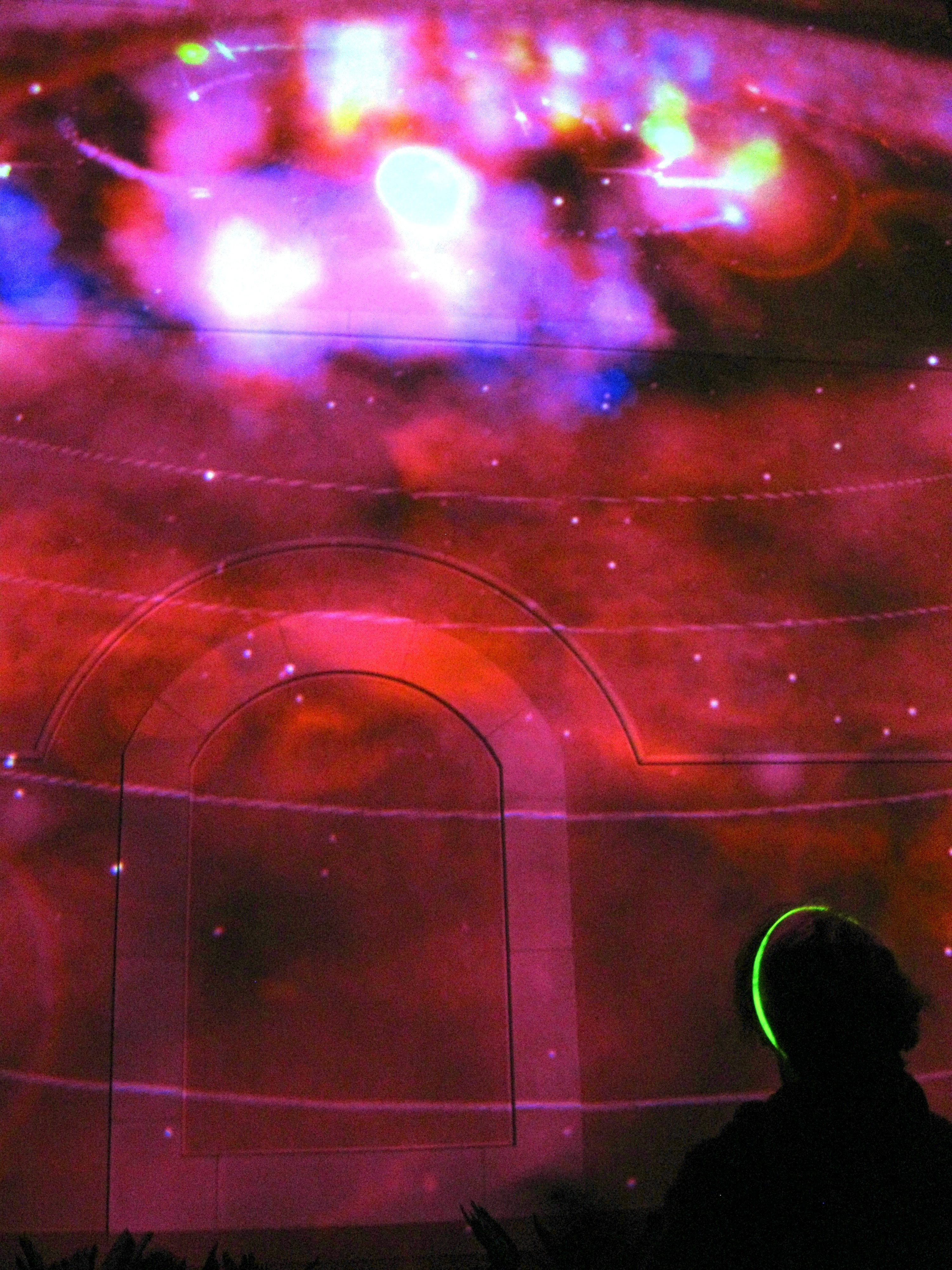
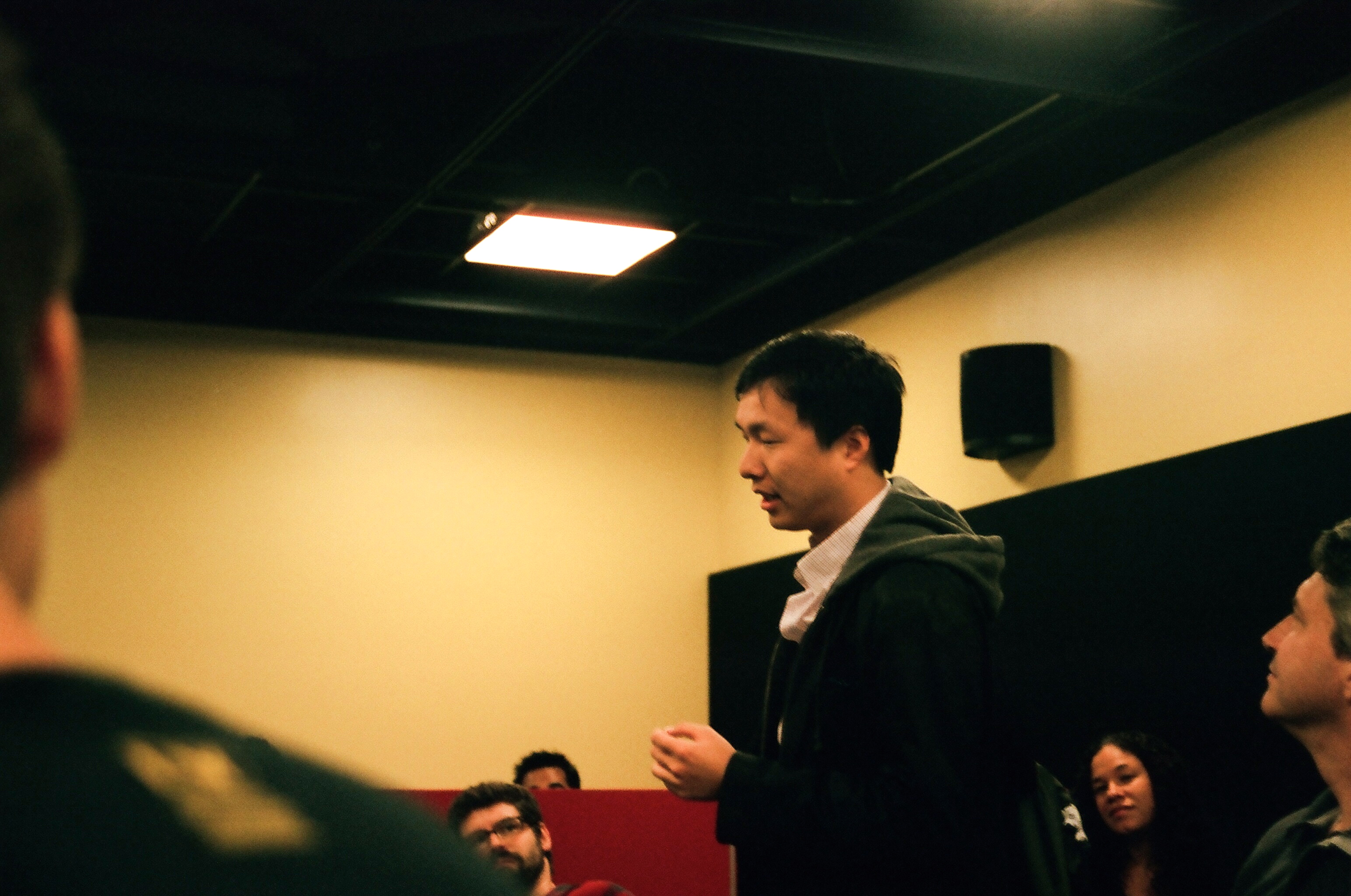
Down Market Street in San FranciscoThis shot has probably been done before. But I shot it.More dramatic shot from Market StreetLooking down Hope St. in Los Angeles. Wish I shot this on film.My friend Zach on the road trip up to GDC (I think I had a post planned for that)Whoa. Trippy.Installation piece at the Rhythms and Visions event at USC.Codeveloper Allison after a Reality Ends Here development meeting.Jenova Chen at the 5D Worldbuilding Conference at USCMy good friends Catherine and Esteban simultaneously photobombing my picture of the wall.Comics booth at the LA Times Festival of Books.Mudd Hall of Philosophy at USC. I like the little cloister they have here.Little hidden library I discovered before class.The Who
So if you haven’t heard, there’s been this weird little indie game that has been going around Steam recently called Surgeon Simulator 2013. It originated as a project made at the 2013 Global Game Jam, and currently, its one of the most talked about games online, and received critical acclaim, numerically beating out recently released AAA titles like God of War: Ascension, Gears of War: Judgement, and Crysis 3.
WHOA
Let’s take a look at what I just said there. This was a game made at a Global Game Jam, a series of relatively underground 48-hour game making competitions. Most games that get created at these events get played only by the friends and family of participants (at least in my brief time partaking in these events). The game defies any notion of what we’d think would merit commercial success and critical acclaim: Surgeon Simulator 2013 is an interactive joke, much like QWOP, it utilizes frustrating controls and silly physics to create hilarity. The game is short, cheap, and deliberately makes counterintuitive game design decisions. By previous measures of rationality, the game should have everything working against it, I can’t think of any Global Game Jam project that received substantial coverage on Kotaku.
And critics are reviewing the game higher than Crysis 3 and Gears of War: Judgement. Mainstream ones too, not the alt-indie leaning sites like Polygon and Destructoid, sites like IGN and Gamespot are doling out these surprising scores. I’m against Metacritic, but color me legitimately surprised and impressed.
Maybe this is a sign of what’s happening with mainstream tastes in games. 2012, a banner year for indie games with the dominance of games like Journey, FEZ, and FTL signified that with the right attention and funding, oddball experimental games can achieve riotous success, even going so far as to sweep the GDC and BAFTA award shows. Maybe the success of Surgeon Simulator is going to push the indie games movement even further.
Surgeon Simulator is an interactive joke. A really good one.
Journey and The Unfinished Swan owed their success to an aggressive experimental gameplay push by Sony, FEZ got its start with a grant by the Canadian government, and FTL jumped into the hearts of gamers with a successful Kickstarter campaign. Surgeon Simulator 2013 got off as a game jam project developed in a span of 48 hours. Kotaku took notice and shared it with their gleeful audience. Someone posted it on Reddit, and the game went viral. Motivated by the reception, the developers decided to push the game further by spending another two months in development.
Think about that for a while. Think about how crazy that would have sounded only three years ago.
Here, we have a game produced without the funding of anyone, not even a Kickstarter campaign. Only the developer’s own funding goes into creating the game, the game is completed over the course of two months. Gamespot, of all sources, goes crazy over the game and rates it higher than the loud, expensive AAA games that people used to get hyped up about.
Cart Life: A Poverty Simulator
Things have changed.
This is the bold new world that gaming is about to enter. The mainstream success of a humble game-jam game, the expansion of mainstream tastes to encompass things like interactive jokes and empathy games, the kind of stuff that Ian Bogost describes better in How to Do Things With Videogames, the fatigue consumers express towards contemporary AAA games, the rise of alternative distribution methods, Ouya, Indie Bundles, Dys4ia and Cart Life at the IGF, and an art-game’s dominance at the DICE awards all point towards one thing.
Ludus Florentis, the movement that James Portnow predicted in his 2009 Gamasutra post. An unprecedented flowering of games characterized by a newfound diversity of developers, genres, subject matters, and development scales. While this movement has already been going on for a while, what Surgeon Simulator proves is that consumers are welcoming, even embracing, this change. In the new world that we’re entering, there will be room for expressive metaphors for life, economic simulations of impoverished people, and yes, even interactive jokes about butterfingered surgeons.
I’m going to spoil a lot of Bioshock Infinite for all of you, so beware this blog post if you’re planning on playing this game.
Bioshock Infinite is a game about a lot of things.
Bioshock Infinite
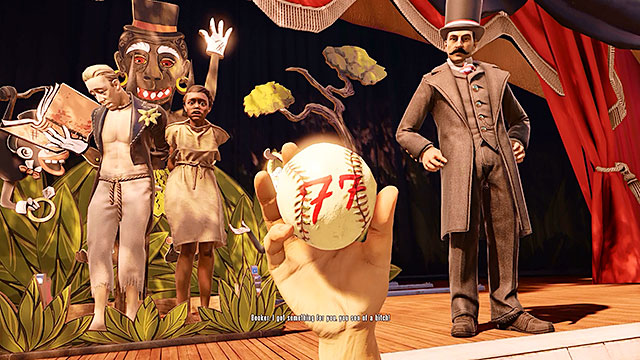
Religious zealotry, American Exceptionalism, theories of space-time and interdimensionality, patriotic jingoism, the inevitability of economic disparity, Occupy Wall Street, colonialism, and problems faced by political radicalism. While few of these plot threads arrive at a productive conclusion, it piques interest, causes uncanny discomfort, and provokes conversation and interpretation within its colorful fan community.
However, my view on the meaning of Bioshock Infinite, which has conflicted with the interpretations of the many friends that I have discussed the game with, involves a subtle level of self-reflexivity that I saw pervading the game’s entirety. Bioshock Infinite is about the nature of narrative in games and the conflicts between emergent and fixed narrative, returning to the conflicts between ludology and narratology that had died down years ago.
Before we begin, let’s go over some key terms necessary to understanding this argument, not everyone is a game designer. Emergent narratives are unscripted stories that come out of a game’s play, they may include dramatic character arcs in The Sims, and alternate histories created by Civilization V matches. Fixed narratives are stories determined by the game designer, and are most prominent in single-player narrative games such as Bioshock Infinite.
Constants and Variables: Emergent and Fixed Narrative
Single-player games like Jak and Daxter are comprised of both fixed and emergent narrative elements. Fixed narrative in these games amounts to preset moments that occur between or during moments of gameplay, and may manifest themselves as cutscenes, background chatter, or narration. Games like these are also comprised of emergent scenes, which can vary wildly depending on player choice. Game narrative is not entirely dictated by the author, and exists as a strange amalgam of both embedded and emergent narrative. Game writers do not have complete control over how a game’s story will play out due to the nature of interactivity and player behavior. Even a single-player narrative game like Half-Life 2 can have an infinite number of narrative permutations dependent on how players approach combat and exploration sequences.
Which is a topic Bioshock Infinite addresses in its brilliant, mind-bending ending. Booker and Elizabeth escape Columbia through an interdimensional portal into the Sea of Lighthouses, a mysterious world beyond the constraints of time and space where every possible permutation of the universe at any possible time in history can be accessed through an infinite number of doors. “There are a million, million worlds. All different and all similar. Constants and variables. There’s always a lighthouse, there’s always a man, there’s always a city… Sometimes something’s different… yet… the same.” says Elizabeth.
This scene is soaked with metacommentary about the distinction and conflicts between embedded and emergent narrative. Everyone who plays Bioshock Infinite will be telling a different story in their playthrough. Combat situations will play out differently depending on player strategies, Booker may or may not find all the collectible upgrades in Columbia, he may spend hours playing carnival games at the fair, he may ride the carousel in Soldier’s Field, and he may scour every trash can in Columbia for food. These are the “variables” that Elizabeth is talking about, the “million, million worlds” that are all different and the same, Bioshock Infinite‘s story is comprised of an infinite number of permutations coming out of the game’s emergent nature.
Decision time!
And yet, the rich range of narrative permutations that come out of interactivity is mooted by authorial intent and traditional narrative. Bird or Cage, ride the carousel or ignore it, fight with guns or Vigors, Bioshock Infinite‘s overarching narrative will always play out the same way regardless of player choice. All this is reinforced by the game’s single ending. While many games try to make player choice meaningful by providing a variety of outcomes based on player’s participation in the story, Infinite mocks the idea by making players powerless over the progression and ultimate outcome of the game’s plot. These are “constants”, the elements of a game narrative that are “always the same”.
The Illusion of Meaningful Choice
Bioshock Infinite is peppered with moments where players have to make a split-second binary choice, such as a decision to threaten or press a ticket seller, and the decision between two different brooches for Elizabeth. While most games like Mass Effect and Heavy Rain hinge upon these moments as an integral part of their branching storytelling, these moments in Bioshock Infinite make no meaningful difference to the overall outcome of the plot.
Games are characterized by having quantifiable and variable outcomes, and player choice in gameplay dictates these outcomes, leading to meaningful play. Bioshock Infinite challenges the notion that binary choice is meaningful by making its choices meaningless, that is, if meaningful choice is to be defined as a choice that influences the game’s outcome. The first Bioshock had a rudimentary morality system where player’s choices in dealing with Little Sisters influenced the plot’s variable conclusion and marketed this system as an integral part of the game’s appeal. Infinite subverts player expectations by making these “moral choice” moments irrelevant to the outcome of the campaign, at most, leading to a minor cosmetic difference on a character or two.
One of the “decision-time” scenes
The artificiality and insignificance of these moments reinforces the notion that Bioshock Infinite is about the conflicts between player-generated and designer-dictated narrative and the diametrical opposition between ludology and narratology. Players are led by prior experiences with similar games to think that these binary choices matter with respect to the game’s narrative, and by subverting these expectations by making these choices almost irrelevant to the game’s conclusion, Bioshock Infinite raises questions about whether or not truly meaningful choice can really exist within a designer-driven narrative.
Does Autonomy Exist in Narrative Games?
The Lutece “twins”, the memorable and quirky duo of scientists lost everywhere in spacetime, provide perhaps the most thought provoking insight on game narrative in Bioshock Infinite. The Luteces are fourth-dimensional beings, and simultaneously exist in all places, at all times, in every possible universe. Adam Sessler of the fantastic Rev3Games channel likened them to Rosencrantz and Guildenstern for their self-referential nature on the nature of fate and free will. This is fitting given their role in the game’s narrative.
Tom Stoppard’s play Rosencrantz and Guildenstern are Dead retells the story of Hamlet from the perspective of minor characters. The play deals with whether or not free will can exist within the world of a play, amongst other meta-things. The titular characters, doomed to die in the original Shakespeare play, attempt to defy their fate by escaping to England in one scene, but are rendered incapable of doing so by virtue of existing in a world dictated by an omniscient, godlike playwright. Video games are said to break from this problem by having the player enact the narrative by assuming the role of a character, thereby imposing free will into a universe traditionally thought to be dictated by an author. Bioshock Infinite challenges this idea in an early scene.
Upon arriving in Columbia, Booker encounters the twins blocking a doorway. They walk up to him and give him a coin, “heads, or tails”, they ask. Booker flips it, calling heads, and it lands on heads, like it did for the last 122 times.
Bioshock Infinite’s coin-flip scene is not a “decision-time” scene
In Rosencrantz and Guildenstern, a similar scene occurs where a coin lands on heads 92 times in a row. This leads the characters to wonder if they are under the control of a supernatural force. In real life, coin flips are determined entirely by random chance, and exist as a fair and impartial way of making binary decisions. This cannot exist within the constraints of a work of fiction, even computers at a machine level are incapable of simulating randomness. The coin-flip scene in Bioshock Infinite is not determined by random chance, and is scripted by the developers to always land on heads.
What this means is that autonomy and procedurally generated narrative cannot exist within a narrative game like Bioshock Infinite no matter how hard developers attempt to give the illusion of an open-ended narrative. The coin-flip scene represented an ideal point to give the player the decision of calling heads or tails, but Booker is scripted to always call heads. This is done purposefully, as removing player autonomy from this scene tells us it is impossible for a game with scripted elements to be truly player-driven.
This notion of the impossibility of autonomy in single-player narrative games is reinforced immediately after the player regains control over Booker. The Luteces walk to the side and open the doorway for Booker to proceed and stand there. If the player stays near them, Rosalind will tell the player to leave several times before saying “If you don’t go, I’ll be forced to start repeating myself.”, after which, she does.
Rosencrantz and Guildenstern are Dead
This interactive scene is a prod at the artificiality of NPC’s in video games, and despite attempts at creating rich and realistic characters in fiction, characters are ultimately fictional constructs created by authors devoid of autonomy and drive. Lutece is scripted to repeat the same limited number of prerecorded lines until the player inevitably leaves the area and continues the game. Despite the fact that players regain control Booker in this scene, it is impossible for players to do anything but proceed down Infinite‘s narrative path.
Look past Freudian interpretations, and this play has interesting things to say on free will.
BioshockInfinite‘s themes of the illusion of free will extend from the artificiality of NPCs to the very nature of interactivity later on in the game. In the game’s final sequence, Booker finds himself reliving the moment he sold his daughter to repay his debt. Booker tries to resist, and players, disgusted at this grim realization, will too. “You can wait as long as you want, eventually you’re going to give him what he wants. You don’t leave this room until you do.” says Elizabeth. At this point, the only option available to the player is to pick up the baby and hand it over to the man at the door, players cannot fight back or escape the room. Players will inevitably surrender the baby, since they cannot progress until they do. Both Booker, and the player, are rendered incapable of making any other decision by the very nature of Bioshock Infinite‘s method of storytelling. Aside from surrendering the baby after waiting for an indefinite time, the only other option available to the player is to quit the game.
So is Booker an autonomous being, or is he controlled by an omniscient force called the Player? Perhaps the question being raised here is whether players are autonomous beings or simply actors controlled by the invisible hand of game design. The interactive nature of the medium would suggest that players are truly autonomous and capable of making rational decisions that influence the world of the game, but all this is an illusion. It is impossible for true, meaningful autonomy to exist in a single-player narrative game because the authored nature of fiction prohibits players from making choices outside of the ones that a game’s system allows.
Heavy Meta
Its totally possible that I’m reading way too deep into Bioshock Infinite. However, even if my interpretation of the game strays far from predominant interpretations of Infinite, the questions raised by multiverse theory, the illusion of meaningful choice, and the myth of autonomy in single-player games raises interesting questions about the nature of video game storytelling. Just like how Rosencrantz and Guildenstern raises questions about the nature of fictional worlds dictated by authors, Bioshock Infinite raises questions about universes collaboratively authored by both designers and players.
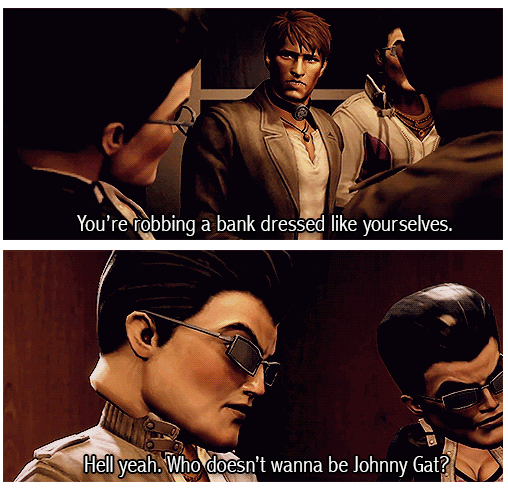
In the initial moments of Saints Row: The Third, irrelavant backstory is introduced with the Star Wars Title Crawl to the tune of the 2001: A Space Odyssey. The game then cuts to a gang assault in an urban basketball court, which turns out to be a Japanese energy-drink commercial, being watched on a character’s cell phone as they prepare to rob a bank. The bank-robbery turns out to be a film shoot. One of the gangsters remarks, “ultra-postmodernism, I love it”, dons a giant mask of himself, and begins shooting up the building.
aww yiss…
Ludonarrative Dissonance: I Promise this is Relevant
One problem I have with sandboxy-action games like Grand Theft Auto and Red Dead Redemption, is that they suffer, more than any other genre, from ludonarrative dissonance. Simply put, ludonarrative dissonance is a problematic phenomenon in video games when a game’s mechanics thematically contradict the game’s narrative. This is mostly caused when game developers try to tell a specific story using the wrong genre.
Left 4 Dead 2 doesn’t try to touch the same emotions as The Walking Dead
Game genre is more than a box of mechanics and design decisions used to codify a game, game genre also determines the type of behaviors and emotional responses that designers want to promote in their game worlds. A slow, graphic-adventure game like The Walking Dead promotes a wildly different set of behaviors and emotions than a cooperative first-person shooter like Left 4 Dead. While both games deal with surviving in a zombie apocalypse, their respective genres each promote the telling of radically different types of stories. The Walking Dead‘s slow, methodical mechanics are intended to promote a melodramatic and introspective narrative, while Left 4 Dead‘s mechanics are intended to promote frenetic excitement and panic.
Which brings me to what frustrates me about sandbox games in general: the types of behavior that the genre promotes fundamentally contradicts the types of stories that developers attempt to tell with them.
Genre Confusion in Sandbox Games
Red Dead Redemption is the story of reformed outlaw John Marston’s attempt to come clean with his past, his quest to bring his former gang members to justice, and his salvation in the love of his family. Over the course of his adventure, he will kidnap maidens and strap them to railroad tracks, rob banks, and shoot up entire towns before riding off into the sunset on a stolen bronco.
If this seems confusing or problematic at all, blame Red Dead Redemption‘s confused choice of genre. Red Dead Redemption‘s somber character drama of salvation, inner-turmoil, and the quest to find peace clashes violently with its genre, making it perhaps the single most frustrating example of ludonarrative dissonance in recent memory.
Red Dead Redemption’s John Marston: evidently a family man.
The sandbox genre promotes a very specific set of player behaviors and emotions. As an open space for freely constructed play, the sandbox-game lends itself to the creation of freely-formed challenges. Powerslide for a hundred meters, jump 200 feet into the water, collect three diamonds to build a pickaxe, run over as many pedestrians as possible, survive as long as you can as cops pursue you. Simply put, the sandbox game promotes spontaneous, free-form play in the form that Callois would call “paida”.
The playful behavior that the sandbox game promotes is fundamentally incompatible with the deep character dramas that games like Red Dead Redemption and Grand Theft AutoIV try to tell. This owes itself to the fact that said playful behavior mostly manifests itself as attempting to drive muscle cars into incoming pedestrians. But if John Marston is really trying to redeem himself and Niko Bellic is trying to escape the demons of his past, why is it that their respective games promote behavior such as driving stagecoaches off cliffs? If Wei-Shen from Sleeping Dogs is an undercover cop, why does he take pleasure in slamming civilian’s heads into car doors? The silliness that these sandbox-games encourage is contradictory to the serious stories that these games have.
Ultra-postmodernism
Which (finally) takes us back to Saints Row: The Third. Here, narrative and genre exist in perfect harmony. Unique amongst contemporary sandbox games, ludonarrative dissonance is not a problem to Saints Row. The game’s world, characters, visuals, and narrative operate with the game’s mechanics as a cohesive whole. While Red Dead Redemption‘s world was populated with incidental collectibles, minigames, and animals meant for hunting, Saints Row‘s world is populated with spontaneous challenges such as hidden ramps, wide-open roads for powersliding, and narrow alleys for running pedestrians over.
The Opening of Saints Row 3
Its also fitting that Saints Row is juvenile, filthy, and ridiculous. Gang leaders are worshipped like celebrities, criminal organizations operate like record labels, and the civilians of Steelport live in a strange mix of veneration and fear of the Third Street Saints, as quick to run away from the player as to beg for an autograph. Phallic imagery bounces about from weaponry to in-world advertisements. Minigames range from throwing oneself into incoming traffic to collect insurance money to riding about in a flaming ATV trying to set pedestrians ablaze. Intertextual references are too numerous to count. Everything about Saints Row’s fixed narrative frames the player’s behavior in Steelport’s sandbox in an appropriate manner.
All this extends to the game’s mechanics, which both expect and reward free-form, “paida”-type play. “Respect”, which amounts to experience points, is rewarded for successfully completing the spontaneous challenges that players may set for themselves, such as bowling over pedestrians with power-slides, surfing atop moving vehicles, and dodging between incoming traffic, leading to character upgrades and other extrinsic rewards. Saints Row is cognizant that players are going to behave in violent and silly ways, and thus structures itself to reward such behavior.
All that I’m saying here is that Saints Row provides a rare example of an open-world crime game actually making sense narratively. Perhaps this owes itself to the game’s self-proclaimed “ultra-postmodernism”, which becomes particularly blatant after the “http://deckers.die” mission. Ultimately, the silly, self-aware humor of the game creates the only kind of narrative appropriate for the sandbox genre. In retrospect, perhaps games like Red Dead Redemption and Sleeping Dogs would have benefitted narratively by limiting player freedom or picking out a more fitting genre for the kind of story that they try to tell.
I’ve been doing games a lot recently. A lot of them are good, some of them are bad. A lot of them are digital console games, others are not.
First up was The Walking Dead, this is a narrative point and click adventure game and one of the most surprisingly amazing things I’ve played in recent memory.
The Walking Dead
The point-and-click adventure game is hard to understand as a game designer due to its lack of emergence. When I work with games, I try to design systems that allow for players to develop skills within systems of interesting rules that are conducive to meaningful play, in other words, one can be good at a game. It means something to be good at a shooter, and it means something to be good at a platformer or a fighting game. What then does it mean to be good at a point-and-click adventure game? After all, success at this kind of game amounts to little more than rehearsing a predetermined set of actions until players reach the end. Pick up that, give it to him, push that, talk to him. If the point-and-click adventure game allows for such little player choice within its mechanics, why then is The Walking Dead so damn compelling?
Maybe its because narrative is so crucial to the player’s enjoyment of this kind of game. Rules of Play defines something called cognitive interactivity, which is “the psychological, emotional, and intellectual participation between a person and a system”. The framed narrative of the point-and-click adventure game imbues the predetermined set of actions needed to progress with meaning. Every puzzle we solve by combining and using objects in the game world is woven with our emotional investment in the characters of the game.
Which makes The Walking Dead a narrative tour-de-force unlike anything I’ve ever seen from a game. Yes, The Walking Dead features only rudimentary dialogue trees and simplistic puzzles. Why the hell then was I moved to tears at the end?
Its because The Walking Dead is realistic with its narrative situations, while dialogue trees in other games provide only binary decisions with clear-cut notions of good and evil, and tie these decisions into mechanics by rewarding or punishing them accordingly, The Walking Dead does no such thing. All important narrative decisions have clearly negative consequences, and are timed, imbuing each of its five episodes with a dramatic tension unseen in the best of games. Making moral decisions becomes not a question of what’s right and wrong, but rather a question of who doesn’t get hurt.
Lee and Clementine
The Walking Dead has players leading a band of survivors on an adventure to escape a zombie-infested Georgia while tasked with protecting the life of a little girl named Clementine. Moral decisions come down to making choices about what kind of leader one wants to be: will you try to be idealistic and inspirational or calculating with the distribution of the party’s extremely limited resources? Will you be able to put aside emotional prejudices in the name of fairness even when members of your group threaten to subvert the integrity of the entire party? Moral questions change from questions of good and evil to decisions about who doesn’t get hurt. Your choices aren’t accompanied by fanfare. No paragon or renegade points are rewarded, karma isn’t gained or lost, the game simply takes note of your decision, nods stoically, and adjusts the narrative accordingly.
And how invested in the narrative you’ll be. The Walking Dead is a taxing game, not on the player’s cognitive functions (the game’s puzzles are simple), but rather on their emotional capacity. By the end of Lee and Clementine’s adventure, I was exhausted and tired from buffet of difficult narrative decisions and the jagged road of betrayals, confused motivations, and sacrificial redemptions. Even if I was simply enacting a scripted set of actions to get to the end of the game, I was emotionally invested in everything that I did in that game.
So what else did I play? Well for one, Super Hexagon represents probably the purest manifestation of the action game that I’ve seen in a while. Its short play sessions are perfect for casual play, and I find myself repeatedly playing the game over and over again, eschewing much more sophisticated play. I often myself tired after long days and unable to muster the effort to consume a big new AAA experience, Super Hexagon is a natural go-to game when I’m afflicted with this apathy.
Super Hexagon
I also had to play through Bioshock,The Binding of Isaac, and Frozen Synapse for my introductory game studies class. Unlike how I’d play other games, I focused on “reading” these games using the Nick Montfort model of game analysis. Its a cool, formalized and academic model for understanding video games at a deeper level. Bioshock is one of my favorite games of this generation, and having the opportunity to replay it, and study it at a deeper level, was a pleasant surprise. Returning to the game after having a deeper knowledge of the economic and philosophical ideas going into the game made the game’s social commentary all the more interesting. The Binding of Isaac was a interesting rouge like that incorporated elements of shooters, which would probably be fantastic once I get bored of FTL. Frozen Synapse plays like a Super Hexagon for a strategy game, easy to pick up and play in those moments of apathy.
And there’s The Unfinished Swan. I’ve been making a concentrated effort to play more of IMD’s (or IMGD, or thatgameschool’s) games. The Unfinished Swan was an adorable first-person puzzle game with a brilliantly pronounced visual style, a telling of a cute children’s story, and made interactive. Its video-game comfort food, a game that makes you feel warm and fuzzy and loved inside. Upon discovering more of the unfinished kingdom, or seeing a cool new gameplay mechanic be introduced, I found myself grinning gleefully. Try it out, especially if you enjoyed Journey.
I most recently began playing Botanicula, its also adorable and will make you squee with joy. Great use of sound in that game.
Are we reaching the point where graphics can get no better? The visual leap between console generations is far subtler than in previous cycles. Adding polygons for each notch in a character’s skin and every strand of his hair is going to make AAA games more time-consuming to do.
Will the need for more sophisticated visuals in games drive up development costs and increase the size of development teams? This will ultimately reduce the number of AAA games that succeed and lead to studio closures and cancelled projects.
Here’s hoping that Sony continues to do its great work in the alt-indie space by supporting devs like Quantic Dream, Giant Sparrow, and thatgamecompany.
Its hard to get excited about hardware right now when in only a year or two consumer PCs will have similar hardware at a fraction of the price. For me, the main draw to console gaming is the social experience of vegging out on a couch with friends in front of a huge screen.
Smart call removing used games restrictions. Bad call removing backwards compatibility. I don’t want to rebuy my games over PSN.
Cloud gaming is overrated, especially for people in areas with slow internet service. Slow internet will effectively shut out a huge number of people from the next generation.
I sure hope the submission process for PSN Indie Games is simple and that the API for developing games is simple and easy to learn. Microsoft did a huge favor for the world by encouraging indie game development with XNA, Sony should consider doing to same.
Maybe Nintendo was right seven years ago when they said that we’re eventually going to reach a point where increased processing power can no longer account for new gameplay experiences. I mean, many of the best games of last year had minimalistic graphics, The Walking Dead, The Unfinished Swan, Journey.Minecraft has weak technical graphics and its already one of the best games out there. I played a bit of Far Cry 3 and felt that it focused too much on spectacle.
Here’s one for new interfaces like motion, touch, and virtual reality.
I haven’t seen any game at the conference that I can get really excited about. Destiny looks kinda cool from an artistic perspective and I’ve adored Bungie’s visual direction, but I can’t really get into the whole “pervasive transmedia-franchise” thing. Time will tell. What I do wish was there at the conference was The Last Guardian, since that dog-goat-eagle thing is friggin’ adorable. Watch Dogs also looks fantastic.
What about support for 3D visuals or 4K resolution? Jumping from 480p to 1080p was a huge visual jump and meant a lot for how impactful games can be. Staying at 1080p seems like a missed opportunity.
Wondering what gameplay experiences the touchpad on PS4 can create. Touch is an incredibly powerful interface and accounted for the success of the DS and modern mobile gaming. If its used in an interesting and creative way, huge potential for great new experiences can be tapped.
People say that this eighth console cycle might be the last. Given how much movement exists with in the industry, the contracting scale of AAA development, and all the new forms of games that we’ve seen over the past few years, that’s probably going to be true. Don’t be sad over this, an exciting new future is about to be built. Be hopeful.
This is actually the most incredible piece of technology I’ve ever seen. Its incredible how they squeezed such incredible machinery into such a tiny device.
So I’ve been shooting on a Canon Rebel 2000. Its a fun camera to use. I picked up a rare roll of Ilford 200 SFX Infrared film, a special effects black and white film used for art-photography that produces strange, surreal effects. Here are the results of a month of intermittent shooting on this roll.
Generally, I composed my shots, but there are a few hip-shots in this set. If anything, this was an interesting, fun, and ultimately nerve-wracking film to shoot on. The unpredictable effects that it has on light and color can change anything.
One thing that has sat on my bucket list for a while is to give a TED Talk. If I were to do one, it would be on video games and how awesome they are and why everyone should at least care about them.
I think that after the casual revolution that came around 2006, video games have infiltrated the public consciousness and stayed there. Add the proliferation of iOS and Facebook games, then everybody’s a gamer. I don’t want to get into the whole “Are Games Art?” argument here, since that argument was already settled decades ago, and any further attempts at justification in this day amounts to nothing more than self-aggrandization Instead, I just want to say that I love games.
Darfur is Dying
Games give us empathy, they allow us to share the experience of another individual by simulating their identities and lives. By actually experiencing the struggles of another person through interactivity, we can comprehend how other people experience the world more intimately than in any other medium. For one, Darfur is Dyingallowed players to understand the crises facing those affected by the Darfur genocide, tasking them with protecting their family from insurgents and managing the limited resources of a refugee camp, risking their own lives to get something as simple as water. Anna Anthropy’s Dys4ia shared the experience of being a transgendered person in contemporary society with its players, a kind of life that I, a young, straight, privileged, male, cannot naturally relate to. Yet, through interactivity, this alien experience can become relatable and understandable, and as a result, we can empathize with people whose lives are radically different from our own.
When teaching about the Holocaust, most schools go to Elie Wiesel’s Night or Anne Frank’s diary to allow students to observe the dehumanizing effects of oppression. If we were to take students out of the role of a passive observer of someone else’s story, and instead place them in the shoes of a Holocaust survivor in a simulated reality, imagine how much closer to home the messages of these stories would hit. Games have aspired to become more emotionally involving in recent years by asking players to make increasingly difficult ethical decisions in their virtual worlds. Perhaps asking players to sympathize with the victims of unimaginable oppression would be a step in a bold new direction for such a movement. If anything, such a game, if done artfully and tastefully, could instill understanding and sympathy within its players.
Games become even more interesting when we consider them as an interactive storytelling medium. By letting our own identities bleed into those of our in-game avatars, as in Mass Effect and Skyrim, we become more intimately attached to the stories that we can create through our participation in a game’s world. Already, games such as Half Life and Bioshock have exploited the perks of an interactive, explorable, medium by using virtual environments to tell immersive stories with rich, imaginative, universes. Things get even more interesting when you approach more experimental games, Spec Ops: The Line self-reflexively questions our enjoyment of violent video games through its subversion of gaming tropes. Journey abstractly touches hearts using a subtle, unspoken language transcendent of cultural boundaries. As a narrative and artistic medium, gaming becomes increasingly hard to ignore.
Pokemon
Looking beyond the potential of games to let us empathize with others, games most importantly serve as a social framework through which relationship can be made. Over a decade ago, Pokemon served as a social framework that united us all, and despite our diverse backgrounds and peripheral interests, most kids in my third grade class had a common interest in Pokemon. We would discuss the teams that we had assembled during recess, surreptitiously sneak our Game Boys to school to make trades, and be envious of the one kid who had that Shiny Zigzagoon. Ask any gamer you may meet, and s/he will recall fond memories of elementary school and the friends that they made playing it. Games unite disparate people, their play serves as a common language through which we bond with each other. Chess leagues, FPS clans, DnD groups, ARG communities, nerdy fandoms, MMO guilds, athletic teams, political parties, games have done an immense social good by allowing us to form authentic relationships with each other and become part of a larger community. If to belong to something greater than oneself is a fundamental human need, then games serve this purpose admirably.
Which is why the reignited controversy over violent video games perturbs me. While I welcome an impartial study on the effects of violent games, the inflammatory accusationsthat I see from pundits are disturbing. I owe myself to games: they were my childhood and their play served as a fundamental building block to my character. In the brief time that I have spent on the side of the developer, my affinity for the medium has only grown. Being part of the USC Interactive Media Division, I stand at the very edge of a rapidly expanding universe, and the future for the medium that I see being constructed by my friends, mentors, and colleagues thrills and inspires me.
Indiecade
I see that future in Reality Ends Here, a pervasive alternate-reality game that has facilitated collaboration and creativity in the students at the School of Cinematic Arts. I see that future in Project Holodeck, a experimental, motion-controlled, virtual-reality interface for playing games. I saw a lot of that future at IndieCade, a festival to celebrate the creativity of independent games. We stand at the dawn of an incredible new age for games, and a vast uncharted future stands in front of us, to step towards a broader, richer, world of games is both thrilling and terrifying, to step back out of unfounded fear of the unknown would be a disservice to the world.