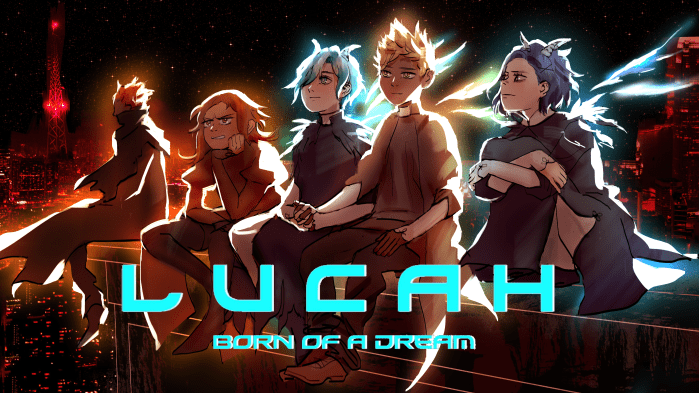
For the last year, I’ve been quietly producing melessthanthree’s incredible action-adventure game, Lucah: Born of a Dream. Lucah released today on PC and MacOS on the Itch.io and Steam platforms, and its easily one of the best games I have ever worked on.
Key art by Brianna Lei
Shortly after Chambara released in July 2016, I was winded and took a few weeks to visit friends and come out of the isolation of the late project. I visited my friend Colin, who was an advisor on Chambara, to test out a new prototype that he made for a melee combat-centric action game. I gave him feedback and testing data and left to go on my way.
After Chambara’s intentional placidity and pacifism, I wanted my next project to be one that embraced and explored violence more directly. The social conflagrations of that year’s election cycle imbued me with complex feelings about rage, conflict, and confrontation that I avoided confronting about during Chambara’s development. That’s why I secretly wanted to work on Lucah and sought to help Colin out any way I could.
I temporarily moved back to San Francisco in the Spring of 2017. In April, I visited Los Angeles to interview to work on a VR project. While I was there, I met Colin in a Little Tokyo coffee shop where I learned he was planning on launching a Kickstarter to make Lucah his full-time job. Having some experience running crowdfunding campaigns, I offered to help him out.
The Lucah Kickstarter launched on June 9th, 2017. Using the skills I picked up from Chambara‘s launch, I developed press releases, handled communications, and conducted competitive positioning research. The campaign was an intense emotional rollercoaster, and as people would pledge, back out, and return again whenever we got coverage, we felt our hopes and faith in the project rapidly fluctuate. Ultimately, we succeeded and raised $22,017 to fund a year of development on Lucah.
In January 2018, I returned to the team as a producer to keep the game on track to release on time, on a budget, and to the standard of quality we wanted. This was a thrilling project to work on, and I’m incredibly proud of what we have accomplished.
Lucah: Born of a Dream is $20 on Itch.io and Steam. Purchase it now and support courageous, personal, and breathtaking experimental work.
I’ve graduated from game school two weeks ago. I’ll write something about it a little later, but for now, I need to stay focused on now and the future.
Immediately in that future is finishing Chambara for consoles. The game is almost ready, and there are just a last few details we need to prepare before we send it forward into the world. In the meantime, you can check out what Chambara will look like at E3 this year because we will be part of the ESA’s College Game Competition. If you’re attending, come by and say “hi” and check out the game.
In addition to that, we’ve released a series of Chambara wallpapers for computers. You can check them out here. We have mobile dimensions of the game’s Key Art too.
Check out our developer diaries too! The last few episodes have featured us and the team reflecting upon our favorite memories from the project. You can check it out on our YouTube channel.
Cathy Trang and Catherine Fox, who are in charge of our marketing and PR for Chambara, launched a documentary webseries of developer diaries detailing beats and stories about the story of the game’s development. We’re going to be regularly updating our Youtube channel leading up to our eventual release. Check them out, share them around, and subscribe to our channel, this is something we are particularly proud of, and I hope it shines a light on what things are like on team ok.
With that brief update, I enter my last week of undergrad! Thank you to all those who saw me on my way. Chambara will have an important announcement at USC Games Demo Day on May 11th, 2016, and if you can make it out to USC, we’d be honored if you could be present for it at this amazing celebration of a wide range of student projects.
Okay, so we didn’t win the IGF Best Student Game Award, but I’m not bummed at all. Huge congrats to Jenny Jiao Hsia and Alec Thompson for winning the award for Beglitched! The game looks great and filled with soul.
Just to be nominated and considered amongst such incredible talent is a baffling honor and I’m proud of how far the team has been able to go. Hundreds of games applied to be considered for this award, and together, we’ve been able to accomplish what very few can. Two years ago, when we were initiating Chambara as a summer project at William Huber’s invitation, I never saw it coming to this. Us, exhibiting the game at the largest and oldest games conference in the world, in front of amazing developers and people who were heroes to me as a teenager. Wow!
The Chambara team on their way out from GDC
Thanks are in order, but I’ll have to save those for when the project wraps up. For now, I’ll just say that GDC was exactly what we needed at this phase of the project. To interact with other game developers doing incredibly creative work of their own and sharing their discoveries and skills in talks and classes is incredibly refreshing, and its hard not to leave GDC invigorated to return to work.
Two months remain in my undergrad. Assuming I don’t royally mess up, things should go well.
Our next exhibition will not be one we can’t attend personally, since it is overseas! We’re exhibiting at the NowPlayThis festival in London, and if you can make it out to that, you should check it out and try all the other amazing art games there.
Furthermore, ICYMI, Chambara‘s trailer and dev diaries are now out! Check them out!
To whom may be reading this, I really don’t write here much anymore. My writing/crit work feels far removed from a lot of the work I’m doing now.
What I’m writing tonight is a bit of an overdue announcement. Chambara has been nominated alongside a bunch of amazing games from students from places like OCAD and NYU for the “Best Student Game” award at this year’s Independent Games Festival! This is an amazing honor and it comes at the start of the next major development phase that we have to do. This is something that I hope that can inspire us to do our very best work and perform at our creative peak as we close this phase of our nascent careers as game designers.
Speaking personally about the IGF, I grew up in San Francisco, and saw GDC happen each year throughout high school. I was never allowed in because liability restrictions prevented minors from going into the conference, so I would catch every talk, awards show, and presser I could through live blogs and streams. It was slightly obsessive.
As a teenager, I watched the IGF awards and would be amazed at how talented and creative these developers could be. The college students that participated in the Student Showcase category seemed to live lives far removed from anything my limited existence could accommodate. My summer camp maze game and twelfth-grade shmup were not comparable at all to what these students made, and I could never see the work that I would make belonging there. Never would I have expected that something I will make five years into the future would be nominated for “Best Student Game”.
Mired in a project, its easy to get into the mindset of just seeing only that which is right in front of you, abandoning the foresight and hindsight to be either reflective or strategic. The Kevin of six years ago would have been overjoyed to hear this news.
But for now, I just feel like leaping into this next, planned, phase of development with the resolve to create the best thing we can for our players and for the world we share with all, and leap we will.
To whom may be reading this, we hope to see you at this year’s IGF Pavilion. We think we’ll have a good build to show you.
This article is long, you can read a formatted, image-free PDF version here.
Through a chance encounter last year, I ended up working as the lead designer for the 2015 USC Advanced Games Project Vanishing Point. Aside from maybe Chambara, this was one of the larger projects I’ve worked on. It was a first-person puzzle platformer where players can manipulate the size and mass of objects in the environment to solve puzzles through a certain kind of forced-perspective, much in the same vein as The Museum of Simulation Technology and Depth.
It was challenging working with the game’s theme and narrative, which attempted to subvert ableist tropes regarding the depiction of mental health issues in popular media, but tripped over itself and either simply averted or reinforced them.
Many games enforce a certain kind of normativity through their harmful depiction of the mentally ill, and use “insanity” as a way to exoticize a villain and vilify them as “criminally insane”. Characters like Far Cry 3’s Vaas and Batman’s Joker reinforce that trope. Mental institutions as settings are not better off either, and often misuse the politically inflammatory implications of a legacy of mistreatment as a way to create an oppressive and hostile atmosphere without critically meditating on what that meant.
While some games might try to tackle mental illness in a more nuanced manner, like Metal Gear Solid 4‘s handling of PTSD and Papo y Yo‘s depiction of addiction, more often than not, lazy writing breeds monsters. The creative direction behind Vanishing Point very explicitly wanted to create a world that did not use problematic tropes with heroic characters that succeed with their conditions.
The game’s protagonist, Rose
The game’s protagonist was a woman suffering from a condition that affected her perception of scale who voluntarily seeks treatment at an institute called Meadow Hills. A doctor there creates a magical device that grants her the supernatural power to physically manifest that condition by scaling objects.
I think a lot of the focus of what Vanishing Point did not say detracted from the focus on what it could say. So the thematic core of what the game ended up doing lacked a powerful thesis, and ended up reinscribing ableist power structures in unintended ways by pursuing the fantastic rather than dealing with stuff closer to home that affects our own lives like PTSD, depression, and anxiety.
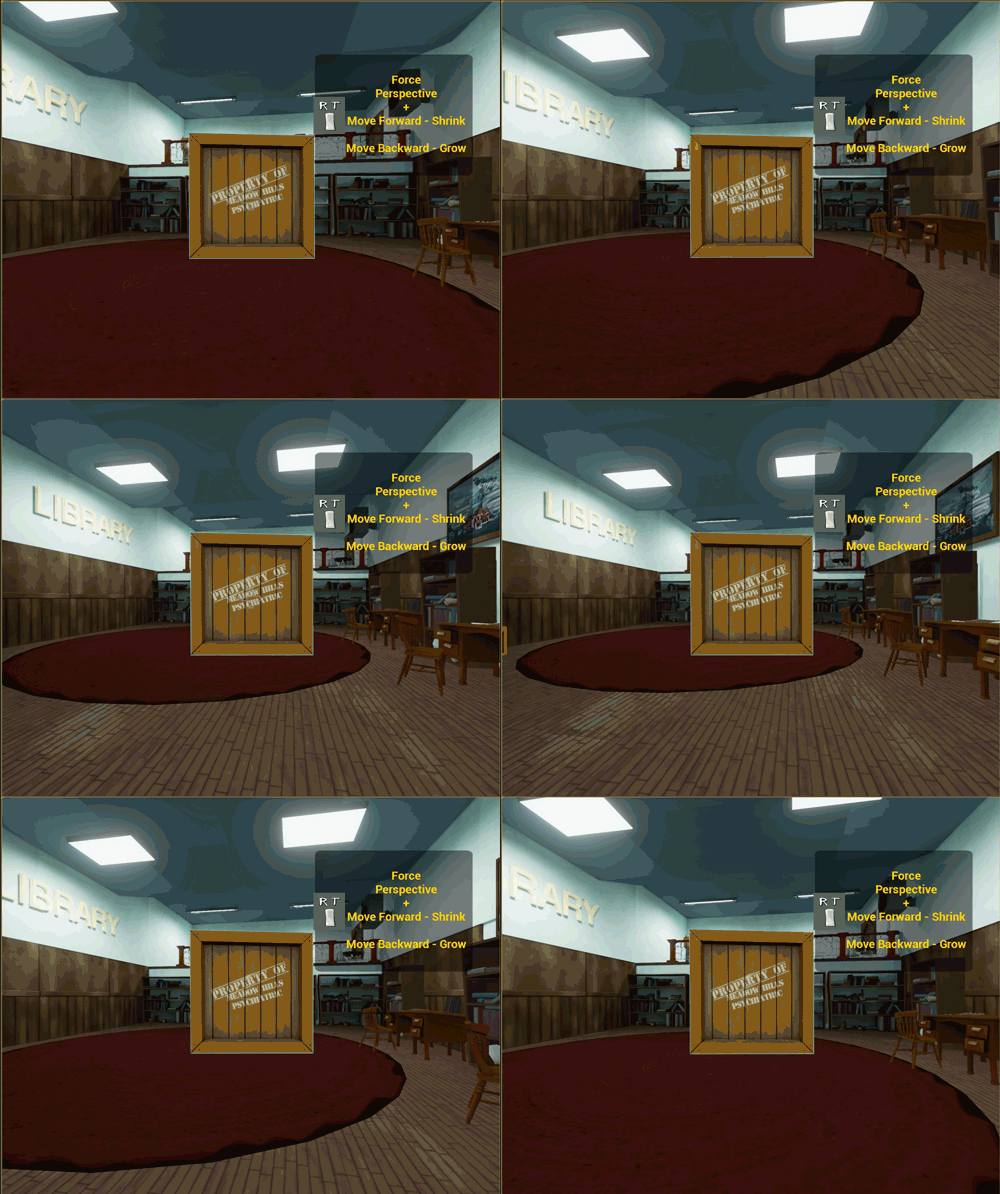
An early example of the scaling mechanic.
The game’s design was part of that. If a game has a very intentional thesis, its argument must be communicated through its every aspect, otherwise you end up with a flaccid ludonarrative dissonance, and Vanishing Point lacked the laser-precise direction to unite its constituent parts into something thematic, relevant, and positive.
Nonetheless, I speak only from the perspective of a lead designer who came onto the project later, after many of the core aspects of the game were settled. I was not in charge of the creative direction of the game, and my focus was spent only on exploring a mechanic. So I should speak mostly of what my experience was on the project and talk about what went right, what went wrong, and what I learned along the way.
WHAT WENT RIGHT
1. PERSONAL GROWTH FOR TEAM MEMBERS
One of the major goals for Vanishing Point was to help team members achieve personal goals and develop themselves as game makers through their participation on the project. To do this, much of recruitment focused on finding people who would benefit the most from participating in Vanishing Point. In the end, I think we were able to help a lot of the people on the team. Team members ended up with jobs they wanted, leadership on later projects, great friends and collaborators, and a clearer focus on what personally excites them about working on games.
2. DOWNSCOPING HELPED WITH FOCUS
Reducing the scope of the game by removing some player-controlled abilities and eliminating the levels that would use them allowed us to more fully explore a single mechanic. A lofty and ambitious scope would have spread the team too thin and forced us to rush levels without the critical thought and care needed to make those levels interesting, fun, and accessible. This downscoping also helped with morale, and building this game felt like less of an insurmountable and dehumanizing task that infiltrated our nightmares and more like a challenging project would push our skills as game developers and bring the best out of us.
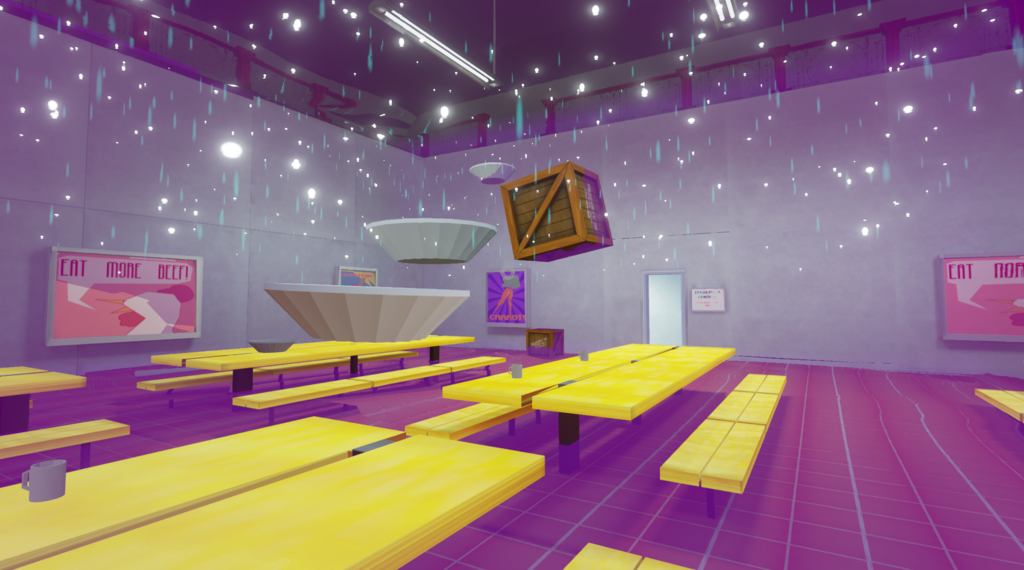
A locker room in the game’s world
3. AGILE LEVEL DESIGN TOOLS
We created a certain kind of “tile editor” for Vanishing Point where levels were constructed of 400×400 square tiles which could have textures and special properties applied to them. Building a map for Vanishing Point was agile and did not rely on very specific modeling and architecting, and changes in level design can be tested and saved or reverted very fast. This allowed us to create better levels with consistent rules, as well as construct secret areas with hidden rewards. The downside to this workflow is that every map ended up with this very clinical, boxy feel that made the tiled construction of the world very obvious.
4. EVOLUTION IN RESPONSE TO PLAYTESTING
Playtesting is important for all games. For puzzle games like Vanishing Point, where all puzzles are heavily authored, emergent behavior can cause situations that could mislead players into false conclusions. Frequent playtests allowed us to adjust puzzles to better dispense essential information and tools, and allow progress in those puzzles to be more clearly demarcated.
That playtesting also allowed us to confidently make deeper changes to how our mechanic worked. Early in the project, we realized that everything about how the mechanic worked simply was not working, and revised it from the ground up. This forced us to throw out everything we built prior to that, but we ended up with a tighter game that was easier for players to learn and granted designers more room to be creative.
Stasis fields make objects placed in them static.
5. MECHANIC WAS EXPLORED WELL
There is a total of 20 encounters in the entirety of Vanishing Point, and while the ability to manipulate objects’ mass and scale does not immediately invite visions of colossal spaces for play like Portal or Antichamber’s core mechanic, I think we were able to create some interesting play by continuously mixing upon that core mechanic. Objects like stasis fields, mass-dependent buttons, destructible meshes brought out the specific properties of the scaling mechanic. UI and usability changes helped make the game as understandable as possible to players playing the game in a gallery exhibition, and efforts were made to make the game accessible to disabled players.
WHAT WENT WRONG
1. VAGUE CREATIVE DIRECTION
The creative direction for the project was unclear throughout its first half, aside from a high-level social goal; questions of tone, mood, theme, and purpose were left very ambiguous. Vanishing Point meandered from being a superhero origin story, to a gritty drama, to a magical-girl adventure. There’s a well-wishing intentionality where you purposefully leave the creative direction for a project vague as to let others fill in the blanks and share creative ownership on a project, and that comes from a good place. The issue with that is, on the receiving end, it often feels like being handed a blank sheet of paper and asked to draw something that fulfills a set of vague parameters. An absence of constraints invites aimless meandering, and not vesting the power to have the final say in someone makes decisive action difficult.
2. EXPLORATORY PHASE LASTED TOO LONG
Development on Vanishing Point originated in Unity but switched to Unreal 4 to give exciting challenges to engineers and permit use of its powerful lighting engine and blueprint system. This was not the best decision for the game or its players because developers had to spend the first several months learning a new toolset and transitioning to an unfamiliar workflow. This slowed development greatly, and entire weeks were spent bumbling around the engine trying to figure out how to make the game with these tools. That delayed that early, exploratory development phase where you are figuring out how to bring out the fun in what you have, prototyping new mechanics and discovering what works lasted all the way to the end of the first semester. This exploratory phase is essential, and Vanishing Point would have failed spectacularly without it. Everything that was presented at Spring Demo Day last week was constructed in a single semester because all the work from the exploratory phase was not of a level of quality that we were comfortable exhibiting.
You can crawl through vents.
3. ART PIPELINE EFFICIENCY
One of the things that we struggled with was the dearth of 3D artists and animators local to USC. Much of Vanishing Point’s 3D art had to be outsourced to volunteer freelancers or non-artists. Thus, asset production was slow and fraught with errors. A single world prop needs to be modeled, unwrapped, textured, and cleaned in order to be ready to be shown inside a game engine. There are special parameters that have to be fulfilled in order for a 3D prop to be usable in Vanishing Point, the pivot point must be exactly at the center of an object and must be built to translate exactly from Maya units to Unreal units. If any of these parameters are not met, that asset must be sent back to whoever built it. With different individuals working at each step of this process, it could take a while for art assets to be ready for integration in the game.
The tile based design workflow is particularly obvious in this screenshot.
4. DIP IN TEAM MORALE
Losing morale sucks. Crunching under a tight deadline when you and the people around you lack it feels like a tragic death march towards an inevitable defeat. In our first semester, we ended up in this state of mind as our major Winter Demo Day deadline loomed by. Folks from the game industry were going to show up at this event, and lots of people were counting on an impressive exhibition to secure jobs. Back then, our game was simply not ready for exhibition, and morale was low and we struggled to want to work on the game. As a lead, I was responsible for perpetuating this atmosphere by feeling this way myself. Getting stuck in a rut where you and your team are consistently in this state of mind is an obvious sign that you need a break.
Furthermore, since most of our team was made out of volunteers who were not taking the AGP class for credit, we had no way to keep volunteer members accountable for completing their tasks on time to a high standard since there was no consequence for receiving a red on a task. When a deadline was missed on an important task, it ended up impacting morale by causing delays and blocks.
5. CORE MECHANIC NOT PROTOTYPED ENOUGH.
Early prototypes of the game were mechanically identical to The Museum of Simulation Technology, where the scale of an object was relative to the object’s position in relation to the player. Over the summer, the mechanic was changed to work by the position of the player in relation to the object. Last summer, I was out in Dundee working on Chambara, and was not involved in the development of this new mechanic and did not have any input in how it function. When I had it in my hands at start of fall and was asked to build levels and new mechanics out of it, I never really felt the mechanic granted me enough room to be creative with design. It was a bit of a shallow foundation to build off of for such a substantial project, but we ended up doing the best we could.
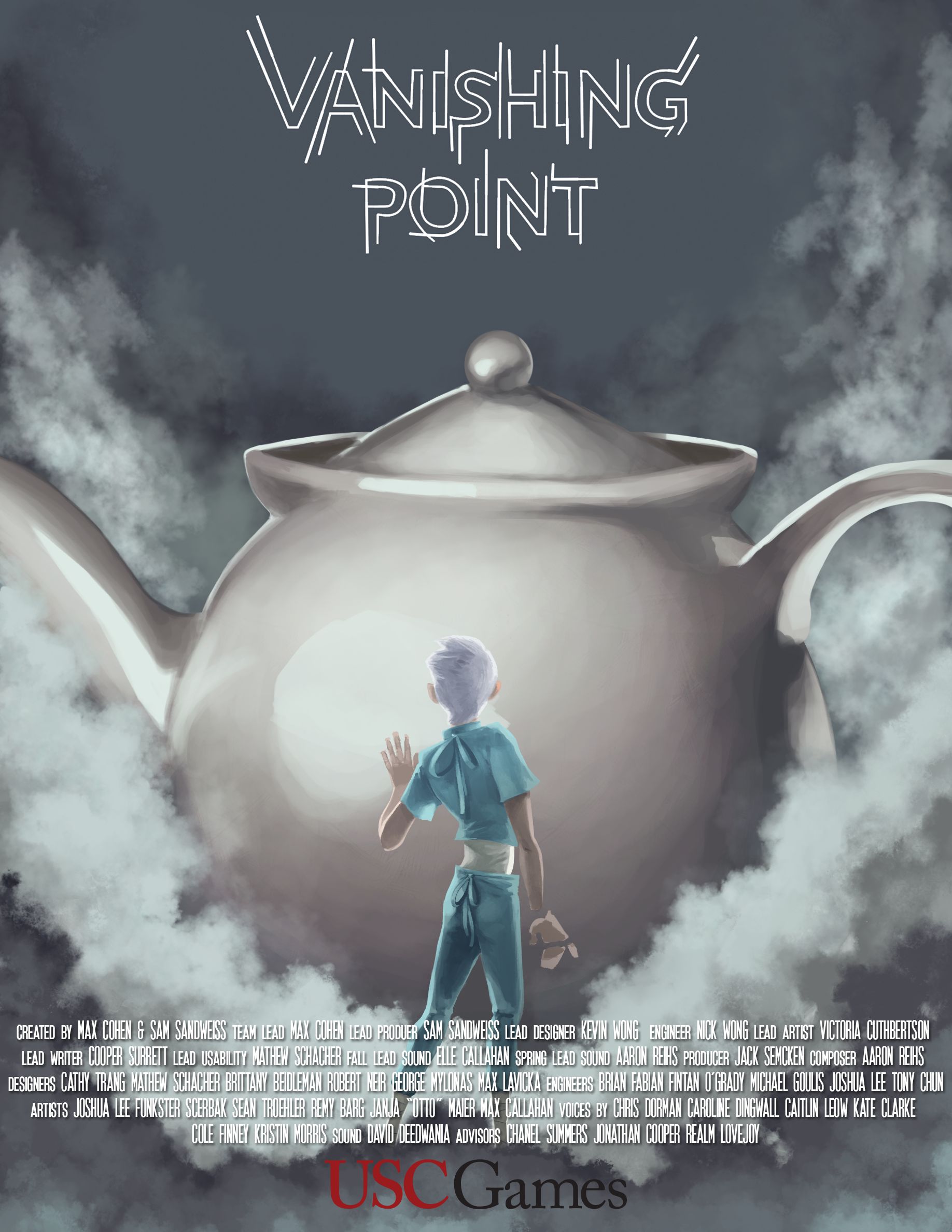
Game Poster
PERSONAL MEDITATIONS
1. HOW TO SAY NO
What makes team members immediately happy and what’s right for the project are not always the same thing. Sometimes you have to say no to proposals and ideas that would come at the expense of the overall project even if folks want to do things their way. It hurts to say no to someone who, say, wants to work on a complex photorealistic shader or texture objects with selfies, but saying yes to everything arbitrarily can detract from focus and cohesion, and balloon the timeline by having people focus on tasks of lesser importance.
2. PROJECT MANAGEMENT IS GREAT
Task lists and effective project management does not only make things operate smoothly and reduce blocks, but it also serves to motivate people by making progress visibly quantifiable and boost team morale. Just because you are intimately familiar with what needs to be done with a game and the priority of each individual task does not entail that everyone else is.
This was my emotional state working on the game.
3. BEING HONEST TO YOURSELF/OTHERS
Be honest and communicative about your emotional state. Its easy to get into a mindset where you hide how stressed out you are, but being open about that can save you from unneeded suffering and prevent you from behaving badly. As a team lead, your behavior sets the tone for the people working with you, and a crappy, toxic attitude spreads around and hurts people. There was a phase where we hated the very Platonic essence of the project, and that manifested in how other people behaved. Everyone has a different source of burnout, and being aware and accommodating will create more peaceful projects.
It is also important to be honest to yourself about who you are and what you can do. It is very easy to get into patterns of harmful overwork by refusing to admit to yourself that you do not have to always be the one to charge into every fight.
4. STAND UP FOR WHAT’S RIGHT
Doesn’t only apply to game development, but life too. It takes courage to speak out when something wrong is being done, but that initiative is important. Everyone wants to see the game succeed, and people welcome critical feedback about their decisions.
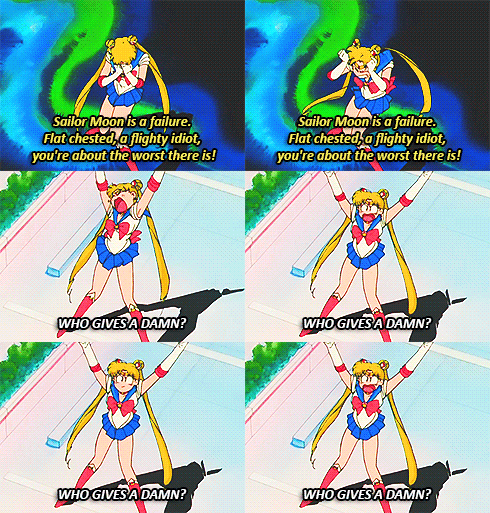
Same.
5. HAVE SELF-WORTH
It is useful to be your own worst critic, but don’t forget to be a fan and advocate too. It is easy to get into a mindset of hypercritical self-skewering and make that fester into self-hatred and feelings of incompetency, failure, and worthlessness. I feel this way a lot. This is very harmful to creative people. There are things to be proud of, and a singular fixation on only the negative aspects of an experience breeds toxic attitudes.
There comes a point in a developer’s career where they transition from feeling proud and accomplished by the fact that they were able to make a game to feeling dejected and despondent that the games they make are not the best they feel they could be. That’s a tough transition to make, and I still feel its sting even as I near my fifth year as a game developer.
6. DON’T OVERASSIGN/SET LOW EXPECTATIONS
You’re working with real people with rich lives outside of game development, and its important to not overtask people and be intrusive. At the same time, don’t underassign work. People want to use their talents, be expressive, and feel valuable to the team, and doing simplistic, boring tasks is patronizing and wrong. The worst you can do is waste people’s time, especially when they are specifically here because they want to work on a particular project.
Sometimes your players like your game more than you do.
7. YOU’RE HERE FOR THE PLAYER
I’ve talked mostly about what goes on with internal team dynamics here, but at the end of the day, your ultimate goal is to create the optimal play experience for your audience. There are self-serving approaches where developers build features or mechanics for the sole purpose of making the game more interesting for them, building alienating features for fun, or creating busywork just to keep people occupied. This approach is right for certain kinds of games, but not for ones that aspire to be welcoming to players and hold them in high regard. I’ve heard a metaphor that preparing the experience of a game is like preparing the experience of a meal, you have to make the experience a positive one for them by ensuring every aspect of the experience serve the pleasure of their experience. Make games as if you want people to have a good time playing, this informed every single decision I made on Vanishing Point.
8. DISTANCE CREATES PERSPECTIVE
Taking a break from a project or working on it less gives perspective and lets you come back with the focus to make better decisions. A bit of time where you don’t touch the project at all does wonders.
This doesn’t really capture exactly what I’m trying to say here, but its close.
9. I STILL LOVE MAKINGGAMES
Game design is a delightfully stressful emotional rollercoaster. It is hard, often grueling with highest highs and lowest lows, and I love every moment of the process. I’m truly blessed to have had the opportunity to work on this and every other game I’ve been a part of, and I’m immensely proud of and impressed by the colossal talent of folks I’ve worked with.
And that’s all I have to say for tonight. There is more that I could say, but the next game awaits.
Production Length: 11 months Staff: 27 Overall, at greatest 23, at least 17 Software Used: Unreal 4, Autodesk Maya, MotionBuilder, Fraps, Microsoft Visual Studio, Blender, Audacity, Budget: 600+ USD
Tracy Fullerton, director of USC Games, recently published this open letter to the community reiterating on the importance of community here, denouncing the violence and harassment of the last few months.
This letter (also published at games.usc.edu) is a statement and a promise to the players, makers, and thinkers of the games community at USC and beyond. We felt it important in these contentious times to put forth a clear statement of our values as a community for all involved in making, playing and study of games. This is for those who currently make and play with us, those who would like to do so, and anyone concerned with the aesthetic form of games and playful interactive media more broadly.
Our goal at USC Games has always been to push games outward from their status quo, with a spirit of adventure inspiring our experiments in the design, development and production of all kinds of games with all kinds of interfaces. We believe that a necessary part of this outward development is to encourage games that encompass new contexts, new audiences, and new creators.
These enthusiastic explorations are only possible in a community that welcomes diversity and thrives on our differences – one that is built on a foundation of humility and profound respect for what our fellow players, our fellow creators, and our varied experiences in the world can teach us. We have such a community here, and it has yielded beautiful results of which we are extremely proud.
However, we cannot ignore the long history of online and real-world harassment of women and minorities who develop, play and/or critique games. The recent intensification of this problem harshly reminds us that an environment of openness and trust is fragile – it requires careful and conscientious nurturing. Accordingly, our community does not accept speech or actions that are hateful, threatening or violent, in any form or forum.
We are adamant in upholding these values and we expect ourselves to have the moral courage to confront destructive behavior when and where it happens, and with an eye to addressing the source of the problem. We believe it is important to apply these principles not only to the academic study and commercial production of games, but to games as a part of our culture and media environment.
We encourage everyone who cares about games – players and makers, amateurs and professionals, aspiring and experienced, academic and informal, casual and hardcore, indie and triple-A – to stand alongside us in maintaining these principles in our words and in our work.
As the hosts of countless game jams, we have found that that these events, with their atmosphere of excitement, collaboration, and fearless experimentation, are a powerful expression of our values. Our student organization, MEGA, wants to offer such a joyful, supportive experience to everyone through its upcoming Love Jam, November 14-15, which will include both in-person and virtual opportunities for collaboration. Please join us in a thanksgiving and celebration of diversity and creativity in games.
Game on,
The Faculty of USC Games
The best part of USC Games is its community, filled with inspiring, big-hearted, courageous, and heroic people. I came here in 2012 in the wake of Journey, and things were so incredibly energetic, optimistic, and hopeful in this community. The flaring of underlying systemic issues in games culture this year has dampened that optimism, and its easy to feel exhausted and drained.
Coming from a world where not very many people wanted to engage with games in the way I did, joining the Interactive Media and Games Division was a homecoming for me. When we got our new building last year, I knew that I was in an amazing place. We had a home. A beautiful base of operations where we could spend time with each other, being creative, being kind, and doing the right work for the world. Here, good folks could meet each other. Diverse friends tied together by a common destiny. Anyone was invited to be one of those friends.
We should be acutely aware of the nastiness, negativity, and evil that exists in our world. And we should constantly self-critique to make sure we don’t inflict nastiness, negativity, and evil upon the rest of the world. At the same time, we should not fill our lens of the world exclusively with sorrow and pain. The form that we are engaging with is about play, joyous and loving. What I want to see happen with the Love Jam is a reaffirmation of the importance of love, inclusivity, positivity, and hope. It’s easy to feel that the world is bleak and hopeless, and I hope the Love Jam will remind us that people are good, games can bring joy, and we can be kind.
Over the last eight weeks, I’ve been in Scotland competing in the 2014 Dare to be Digital competition, an international game jam where college teams from all over the world strive to construct a game in a two-month span. The three winning teams of this competition go on to be nominated for that year’s Ones to Watch award from the British Academy of Film and Television Arts.
My team, Overly Kinetic, was nominated for our game Chambara, a binary-colored split-screen stealth game inspired by a Samurai Jack episode. Creating Chambara at Dare was one of the most challenging and exciting times of my life, and definitely a highlight of my career. At our booth at the Protoplay Festival, I saw for the first time, people laugh and smile with each other as they played our game. To think that something I made gave such a positive, loving, experience to people, that’s amazing.
Here are my personal thoughts on the project and how it went.
WHAT WENT RIGHT
1. Preproduction paid off.
Chambara underwent an extensive preproduction period that extended for multiple months. Conceptualization and team-building began as early as January, and preparation for the pitch extended all through early May. The team met for three hours every Tuesday to plan for the pitch, prepare documentation, assemble project plans, consider funding solutions for our flights to Scotland, and conduct physical and digital prototyping. Our Tuesday meeting was often followed up by a weekend meeting where we would conduct research by watching chanbara movies or current anime, as well as playing games like Metal Gear Rising and Timesplitters. Over the course of those months, we discarded as many as three scripts for our pitch video and two project plans.
The result of our extensive preproduction period was an exceptional pitch video and high morale throughout the first week of Dare. Knowing every task we had to do to complete this game down to the hour, we worked game-jam-like hours through the first week and completed a playable prototype within three days.
2. Polished core mechanic.
The intentionality of my previous game, The Pilgrim, was to explore what game feel and character controls could communicate emotionally to the player. The “feel” of a jump can communicate anything from empowerment and joy, to disempowerment and frustration.
To this extent, much of the success of a character-action game comes down to the kinesthetics of movement through a space, which is why it was of utmost important that the “feel” of moving about in Chambara was empowering and playful.
Level design was blocked for a week because we could not reasonably create levels until we understood how players would feel moving through them. Once Alec designed an excellent, fully-featured character controller with some advanced movement features like gliding, walljumping, and blocking, we began to construct levels around those features. Subsequent iterations of that controller would add features such as variable walk speed, remapped controls, and a “squawk button”. Ultimately, the game owes a lot of its success to game feel and the tactical depth afforded by our movement system.
3. Rapid iteration and playtesting.
A mantra of game design is “fail fast, fail often”, which upholds that it is extremely important to have some testable proof-of-concept as early as possible and iron out the flaws from there. The reasoning behind this mantra is that the earlier that flaws with a design are discovered, the earlier those flaws can be corrected, making the process of creating a game an inward spiral of course-correction and continuous refinement. To this extent, we were successful. We implemented, tested, and discarded several of our ideas from preproduction on the very first day.
One of our first testable levels
We ran extensive testing outside of the one public session that Dare to be Digital arranged for us. We treated every industry mentor that came in as another playtester, and studied their play-behavior very closely, down to tracking notes on how they moved their thumbs around the gamepad. Their reactions and feedback would form the basis of what we wanted to build and implement the very next week. Each of us would send builds back to our friends and family to get their feedback, and a comprehensive metrics backend provided us with ample data that we weren’t entirely sure how to interpret.
4. Simple assets.
Building a Chambara map is easy: simply drag and drop cubes, deform them, and throw one of two materials on each block. For a while, many of our environments were constructed entirely out of 3D primitives, which led to some delightful moments when I threw rigidbodies onto everything. For a short time, we had “leveloution”.
Around the sixth week, we determined that we needed to art up the levels to give them more grounding and readability, as well as solve the problem of players not being able to determine where the boundaries of a level were. So we began to construct art assets to replace the primitive cubes and planes that used to build up the levels.
Constructing these 3D assets was shockingly easy, especially given that our dichromatic aesthetic nullifies the need for UV maps and textures. Every asset I constructed was a simple cube with faces cut into it, each of the faces would receive its own material. This pipeline allowed us to create and implement 3D assets in only a fraction of the time it would have taken if we had used any other art style.
5. Multiplayer is exciting to design for.
While I was involved with The Maestros back at USC, I was only working on that project as a community manager. Chambara was my first multiplayer digital game, the rest of my projects being either single-player digital or multiplayer analogue. Working and designing a digital multiplayer game was a refreshing change of pace from the kind of work I’ve done in the past, and making this a project I was really invested in.
WHAT WENT WRONG.
1. Bad timing hurt some components.
Despite all the preproduction and planning we did, something would inevitably go wrong and throw the project off schedule, which is why we designed our game to allow for features to be cut or suffer without hurting the core game too much.
We worked on an asymmetrical schedule with our composer Austin, who was operating from four timezones away. Since we were working on this game full-time and he was working part-time, we inevitably moved the pace of the project disproportionately fast. We would build levels and features and put in requests for sound assets and music faster than he could reasonably create them. There were multiple times where we would request a sound effect for a feature that we would have to cut days later, thereby making him do unnecessary work.
We also planned for a comprehensive UI revamp later in production that we were ultimately unable to do. The main menu seen in the festival build is filled with a lot of issues, making it very inconvenient to set up games and match players to teams. Ultimately, we had to create temporary solutions by revamping the existing menu system and creating UI assets that were not as rigorously tested or refined as they could or should have been.
2. Health.
One of our team members got very sick later in production and was unable to come to the studio every day to work on the game. While we crunched much less than we would typically do during the school year, we still made sacrifices to our health in terms of diet and exercise. Affordable food options in Dundee are limited, and much of our diet came down to refrigerated tortellini and sandwich meat from Tesco, or processed meals from a frozen-food retailer called Iceland.
3. Budget
All Dare teams are allotted 200 GBP to use to spend on production of their game. We were confused as to how to use this money, because you don’t really need much money to make videogames. So early in production, we decided to save that money up for our Protoplay booth, which we wanted to be a welcoming, homey environment where people could come in and play our game and receive a prize for playing.
The American dollar isn’t very strong against the British pound, and expenses in our own currency were far greater for us. A 20 GBP expense was equivalent to a 35 USD one, making us reticent to spend.
Ultimately, we ended up going over budget and had to pay some of the expenses, like branded t-shirts and crafting gear with our own money.
4. Inconsistent theming.
While we spent much of our research phase in preproduction looking at samurai cinema and anime, very little of that influence made it into the final game. Visual tests of our levels over the first two weeks revealed that people associated our imagery with German Expressionist film, with its harsh angles, angsty edges, and dreary colors, which was a connotation that we didn’t find fun or appealing to us. Others said that the visuals reminded them of Frank Miller’s Sin City, which brings up a load of sociopolitical issues that we aren’t prepared to address.
We started art-ing up the levels around the sixth week and giving them life and thematic grounding. Nonetheless, the look and feel of the game remains inconsistent across the game’s five levels. “Glorious Mansion”, our two-player level, brings up European connotations with its red and white color scheme and its ornamental accents and assets. “Neo Tokyo” is a strange mashup of Akira’s late-80s cyberpunk style and utopian metabolist architecture. “Flour Mill” sticks out with its industrial gears, mechanical ticking, and wooden slats. “Mono-Ha Garden” is the only stage that uses cylindrical shapes as its base asset and is inspired by the Mono-Ha art movement of the 70s. “Reservoir” was actually a map that we didn’t have time to finish, and remains constructed entirely out of primitives. A number of silly easter eggs in the hills are its only theming.
5. Ethics?
We knew that the primary audience at the Protoplay Festival would be children, roughly 7 to 14 years old, moving into the competition, and felt that there were many ways that we could do something very harmful to them, as well as create a problematically racist appropriation. People change through experiences, and since videogames offer experiences, we knew that we could have a very negative effect on the values of our players. I discussed this problem in depth in my previous blog post about the subject.
While we made extensive measures to neuter the violence of the game and spin the mechanical interactions into something positive, I don’t think we did enough. When a mother at Protoplay dismissed our game as “another killing game”, I was deeply hurt. If anyone reacts that way, I don’t think we did enough. The formal systems of games necessitates conflict between players or systems, and to struggle against the structural foundation of the medium is a vast challenge that I doubt that we can pull off. While the magic circle indictates a separation between the world of a game and reality, games and the behaviors that they create through their systems are inherently political expressions. If the values expressed through our content are dissonant with what we believe, then I think that we would be doing something we would regret in the future.
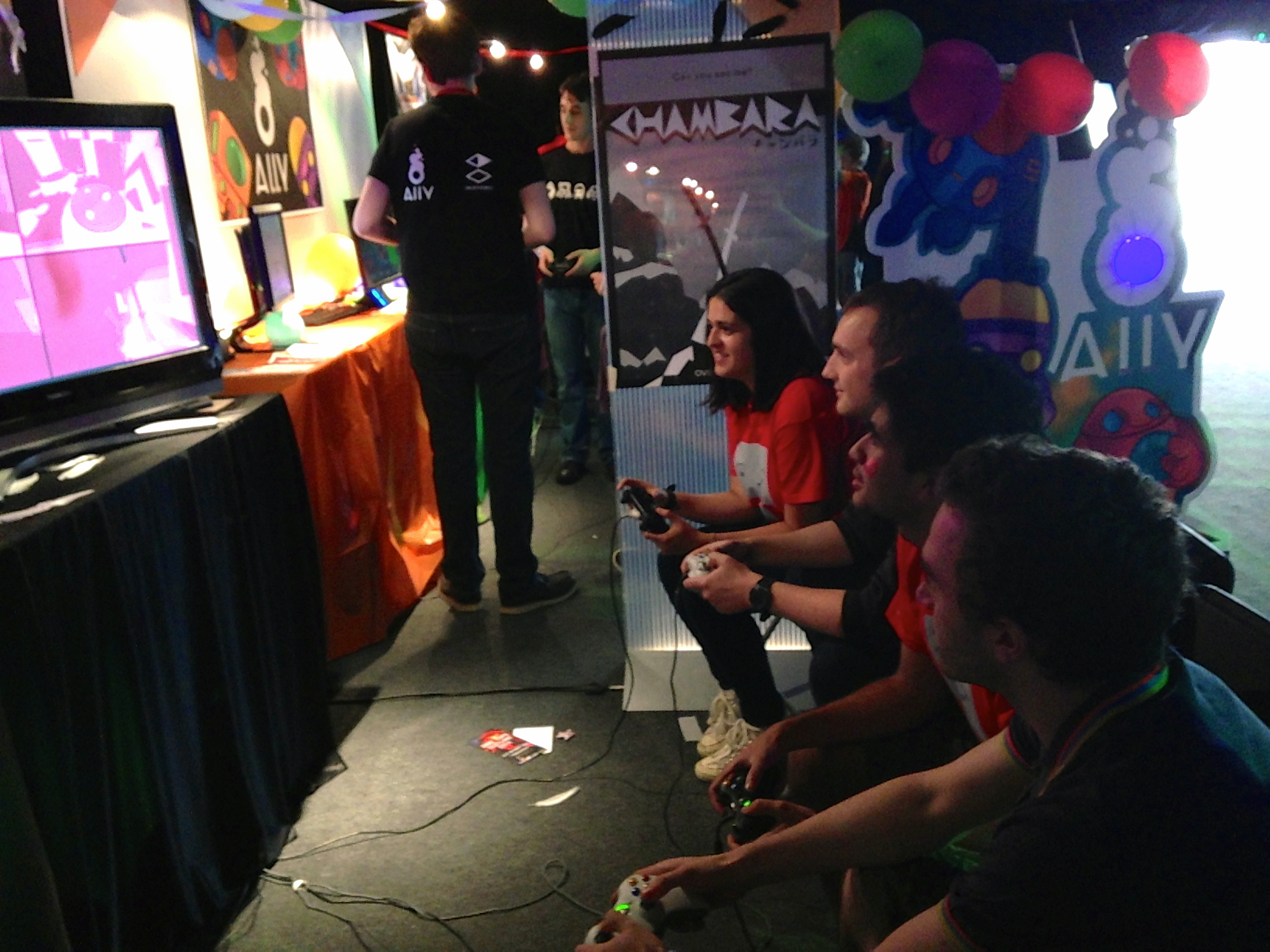
Chambara’s debut at protoplay was very positive and warm.
Civilization is a great game because its systems encourage competition between players, creating brilliant emergent narratives. But when those systems in context are metaphor for violence, imperialism, and ultranationalism, I can’t really say that Civilization is a comfortable game once I leave its magic circle.
Which is why a single person calling Chambara “another killing game” is so perturbing to me. If our systems of conflict are construed to be about violence, anger, and confrontation by some people, then what does our game communicate to our players? Do our players leave the experience better or worse?
I think we mostly succeeded, I saw nothing but positive behavior from people who played our game. Kids and adults laughed, smiled, and bonded with each other as they played our game, often shaking hands after they were done. We witnessed no toxicity and had a greater diversity of players than we expected, entertaining young girls and older parents, people underserved by existing games. A father with an autistic child thanked us giving his son something to smile about, which really made our day, and overall, I think we created a lot of love in that festival tent. Yet, I can’t forget what that mother said, “oh, another killing game”.
Nonetheless, if Chambara ended up being the blood-drenched mess of violence and negativity that it could have been, presenting itself as yet another “killing game”, then I don’t think I could accept a BAFTA nomination in good conscience.
FUTURE
We intend to retrieve the rights to Chambara from Abertay University, who manages each team’s IP for the duration of the competition. What exactly we’re going to do with those rights remains to be decided. If we choose to develop the game further, we might self-publish on Steam Greenlight or Playstation Network, or pitch and sign on with a publisher. We will probably solicit our professors for advice on what to do from here.
We would like to submit to indie festivals like Fantastic Arcade, The Wild Rumpus, and Indiecade. It would be fun to travel to games events like EVO and essentially go on “tour” like what Nidhogg or Killer Queen has done.
If we can’t decide, we’ll probably open-source the game’s project files and make the game free to download, essentially donating the game’s source code to the public domain so people can poke through the code and assets and learn how the game was constructed. Open source is a great thing for education, and given Unity’s omnipresence in amateur games, I think we can do a lot of good for the world if we surrender our code.
We’re closing out on Week 7, and I’m somewhat comfortable calling what we have here as “Alpha”. Next week will be the last week we have to finish the game, then its on to exhibition at the Protoplay Festival. The result of our presentation there will determine whether or not we will be nominated for the BAFTA’s Ones to Watch Award or any of the other prizes.
We ran a playtest on our game late last week on a number of kids from a local summer program. We learned a lot about our game’s new player experience and how learning navigation of first-person space works for young people. A lot of that probably comes how a lot of these kids grew up playing games like Minecraft and how they attained their initial literacy in games through it. We’ve made a number of changes to our game because of it. I hope we’ll have time to complete all of the changes we need to make in the next week and a half.
We ended up being featured in VICE Magazine’s The Creators Project, and that interview got us quite a bit of buzz over the last week. I just finished up an interview with Develop Online which should go up in the next few days. Hopefully, we can sustain that momentum to Protoplay, as the judges seem to factor our behavior and outside interest into account when interacting with our games.
Clash
This week, the team has been mostly focusing on gearing the game towards a festival context. We have removed stages inappropriate for new players and gave players a pre-game sandbox to run around in and get accustomed to controls and space. Alec has been working on a new UI system that would be more usable than what we currently have now. The number of stages, which used to stand at around nine, has shrunk down to five, allowing us to focus on adding representational elements to levels to give them a sense of context, place, and fun. I’ve been implementing sound effects as they arrive and cutting together a trailer for the game, focusing on communicating the mechanical and aesthetic uniqueness of our game. I’ll post that once we’re happy with it.
We’re in charge of handling a budget of 200p at Dare to be Digital, roughly $350. We’ve allocated almost all of that money towards our booth for Protoplay. I’ve been to Indiecade and Glitch City parties before, and there’s a unique social context in that kind of event/festival setting that I really want to leverage. Killer Queen does this really well, as does Sportsfriends, and Spin the Bottle. Only at a festival can you play with complete strangers and bond with them over games in a social atmosphere that’s both celebratory and community-building.
Whoosh
So we want to construct an inviting booth that meshes well with the dichromatic aesthetic of the game. A “living-room-in-a-expo-hall” where people can drop by, have a great time, make some friends, and chill out in a social context that many find exhausting. I saw a lot of that come out of the Mild Rumpus at GDC, and with our limited budget, I hope we can achieve something unique there.
We aren’t [only] designing games, we are designing experiences, and experiences are the only things that can change people, sometimes in unexpected ways. (451)
If you aren’t willing to take responsibility for the games you make, you shouldn’t be making them. (455)
is it possible you could find a way for
your game to do good? To somehow make people’s li ves better? If you know this is possible, and you choose not to do
it, isn’t that,in a way, just as bad as making a game that harms people? (456)
Chambara has begun to grow legs and get attention outside of the tiny circle of people following our journey in Scotland. After an imgur album of gifs hit the top page of reddit’s indiegaming board, AlphaBetaGamer got a hold of the images and shared them on their site. Soon afterward, a tumblr post featuring those images hit 250 notes, and I received a message from Vice asking if they could do a story on the game. Soon, we will have to be accountable as to what our game represents to the outside world.
I look at the above lenses that Jesse proposes about the game designer’s responsibility to the world and wonder if our game can really offer a sound response to those questions.
Civilization 5
I’ve been playing a lot of Civilization recently, a game that I immensely enjoy and find to be an immaculately designed story machine, spewing out amazing emergent narratives. Yet, I am uncomfortable about how much I enjoy it. Civilization‘s winstates and mechanical progression prioritizes disagreeable values about imperialism, cultural hegemony, and state-centric nationalism. Yet, it is these uncomfortable values that create an incredible game.
Our game is a fighting game, where the conflict is violent and resolved by the elimination of the other. Thus, we start off with some uncomfortable themes such as the resolution of interpersonal conflict through fighting, redemptive violence, and the need to “right” the world by killing the human beings which make it “wrong”.
I don’t think those values are representative of what I believe.
I found one of the recent projects I was involved with disagreeable because the mechanics and metaphor came together to create something indicative of imperialism and the subjugation of native people for resources. It was an RTS where competing players farmed resources to fight each other by attacking a peaceful, NPC faction at the center of the map, with the overarching goal of using these resources to wipe out the other players. While the game was incredibly polished and impressive, I wasn’t sure if being involved with that project was right for me and my purpose in the world. Even if I admired the design aspects of the game, I wasn’t certain the values it communicated were what I wanted to give to the world.
Even then, our game does not have to be that game. We can rise beyond redemptive violence, binary judgement, and the dehumanization of the opponent. There are a large number of positive values that can be communicated through games about oppositional conflict. Elements like sportsmanship, respect for the opponent, self-improvement, and graceful defeat. In being a split-screen game, where positioning in space is important to victory, players can literally understand their opponents by viewing the world through their eyes. By drawing close and comprehending their opponent’s differing perspective, players can succeed.
Yet, that does not resolve all of the game’s issues, how players treat and understand the act of lunging forward to stab an enemy is the crux of the matter, even if spatial understanding is a matter of empathy.
When the end result of that empathy is the defeat and subjugation of your opponent, those semantics get compromised. Granted, the contextualization and semantics behind the kill don’t have to be grounded in destruction and violence, if represented in the right way, the act of attacking your opponent can be imbued with positive values.
Maybe I’m getting worked up about nothing. After all, the theory of the magic circle and its associated metacommunication dictates that in entering the mental space of a game, players perceive things differently, and confrontational actions are understood to be playful. Yet, I can’t help but feel that my involvement with games criticism and writing obligates me to be cognizant of what the elements of my game mean and how they influence/are influenced by the world they exist in.















 KEVIN JAMES WONG