Things have been going at a good pace for Chambara right now, I bought us a website recently, which you can find at http://www.chambaragame.com. Our second set of deliverables, marketing materials for programs for the ProtoPlay festival, is due early next week. We have a good prototype done and recently finished up our very first public play test, and are planning on doing a public, internet play test within the next few days. Very soon, you’ll be able to download and play the current version of Chambara on any Windows, Mac, or Linux computer, provided you have a supported USB controller and a friend to play with.
I want to do something like a standard games postmortem for this project, but write it during active development, rather than doing so after the project is done. I believe acknowledging our mistakes and successes will let us learn from our issues faster, allowing us to course-correct better during the process of development.
WHAT’S GOING RIGHT
1. Thunderingly Rapid Prototyping
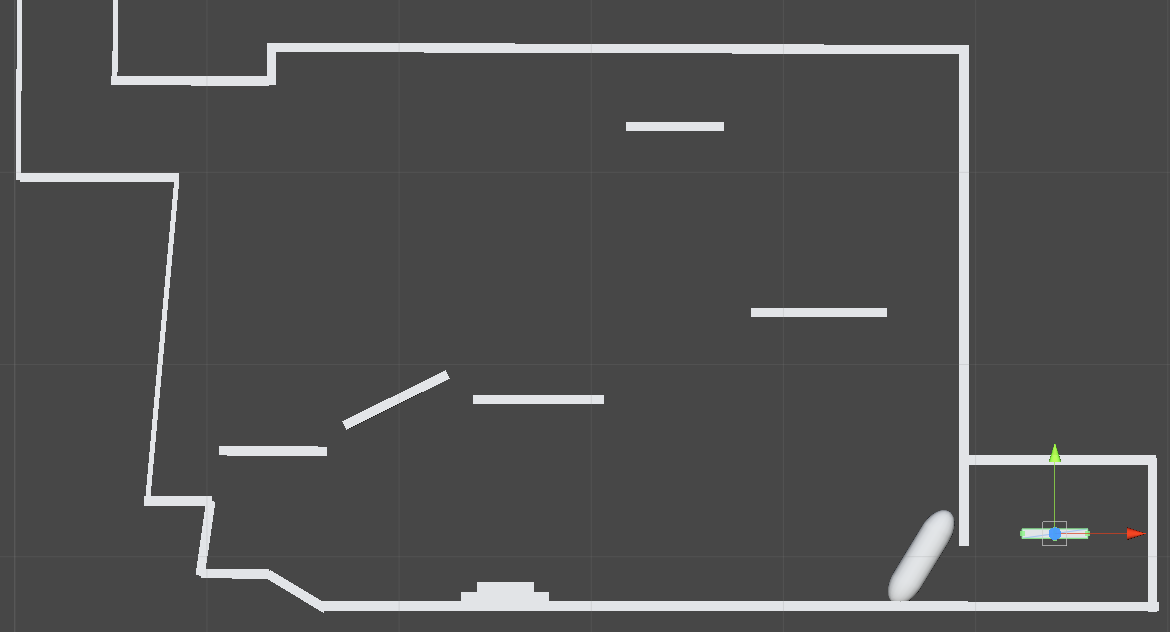
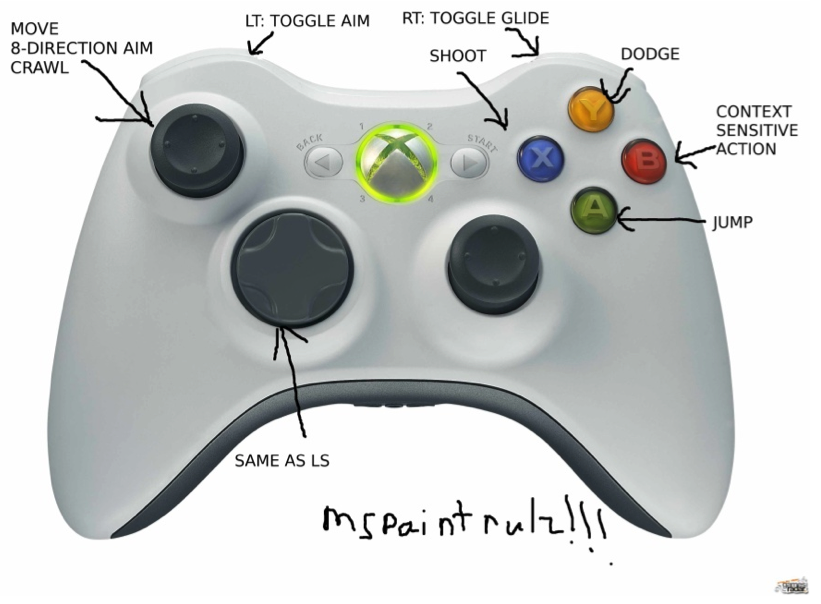
The first week of development was the most intensive. Having been accustomed to crunch time while juggling classes and development on The Pilgrim, we hit the ground running at a thundering, breakneck speed, arriving earlier and leaving later than most other teams at Dare to be Digital. We had a prototype up and running by the second day, which allowed us to see our ideas in action very quickly and better understand what does and does not work for this kind of game. We revamped movement and created our own custom character controller and a large number of test levels to learn how to design interesting, exciting action.
2. Experimentation
Much of the existing knowledge about level and game design is not applicable to the kind of game we’re making. We can’t guide our players with lighting, paths, and textures, and weapon balance is not a matter of balancing numbers on a spreadsheet. The Counter-Strike “Figure-8” loop is totally inapplicable for what we’re trying to create, rendering a lot of existing design writing and talks in a state of limited usefulness. This leaves us to discover what works and what doesn’t through our own experimentation. Exciting.
3. Fast Development & Testing
The best part about our workflow is that texturing and UV-mapping objects is totally unnecessary, making our asset pipeline extremely fast. By constructing our levels out of primitives, we are able to construct testable levels in hours rather than days. The benefits of this agile workflow are innumerable, and has allowed us to reach a polishing phase in a matter of weeks. The development plan that we established during the Spring has been totally burned through, leaving us tens of hours ahead of schedule. I expect that the game will be in a state where we will be comfortable showing it to the public by late next week, and I’ll move forward on creating a web presence for this game on indie games communities and submitting to festivals like Fantastic Arcade.
WHAT’S GOING WRONG
1. Unified Artistic/Ethical/Thematic Vision
During preproduction, we didn’t see the value in establishing guidelines for the kind of game we were trying to make. We didn’t write any design documentation, we didn’t establish an Art Bible, nor a vision statement. As a result, we’ve spent the last several days in conflict about the thematic direction of the game. There are some who want Chambara to be an edgy-cool game inspired by the best elements of Batman Beyond and Samurai Jack (our original inspiration),while others want to create something cute, goofy, and playful, while others want to create something subversive of the oppressive heteronormativity inherent to the form.
These disagreements have slowed down production, and nailing down a character design was a process that took more than twice as long that I hoped it would. Retrospectively, establishing that vision prior to development and agreeing that the project is a shared effort between all of us would have saved us much time and frustration.
2. The Doldrums
I see the job of producer as an ultimately personal one, assuring that the participation of each team member fulfills their own personal needs and that they’re always working on something interesting to them. A disproportionate distribution of participation in a project is harmful, and being tasked with nothing to do while other team members are heavily involved isn’t fair.
Granted, this issue comes from the fact that some of our time was spent puttering around waiting for certain tasks like character design and controls to be finalized by another team member to be completed, removing blockades on progress. So I expect things with move much more smoothly later on, though I want this to be something that we are very cognizant of.
3. Unclear Milestones
Because we burned through our development plan, we find ourselves far ahead of schedule. Our core feature list is more or less complete and the prototype has been proven to be fun and accessible. So the path onwards is unclear. Features are envisioned and implemented on the spot as we wander around, trying to figure out what we can do to take this game further. We’ve been considering new maps and game modes, but we can only go so far before that extends the list of needed sound assets far beyond what can be created and implemented in time. I’ve worked with metrics and outreach to communities like reddit indiegaming, but I feel that such measures are unwelcome by my teammates. I am interested in working with cheat codes, game modifiers, or easter eggs, but will need finalized decisions about UI and design before I take that on.
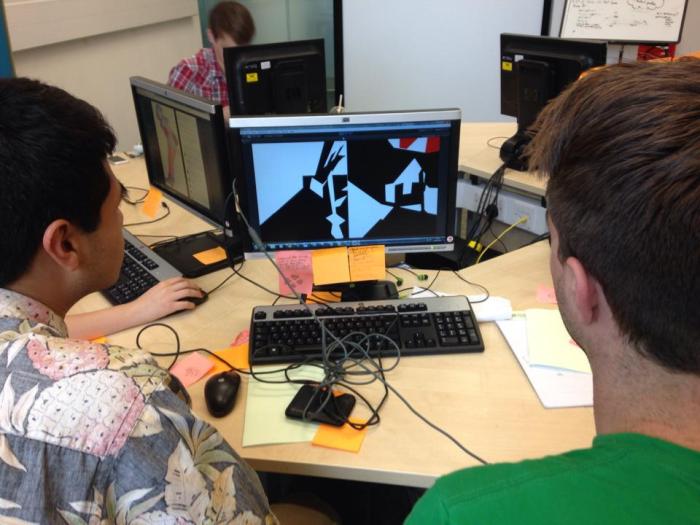
Day 4 of 2014’s Dare to be Digital international game making competition has concluded, and we’ve been moving remarkably fast. We’re basically making this game with five strong designers, which means we’ve been in a lot of disagreement with a lot of the decisions to be made with aesthetics, functionality, and mechanics. We jammed out a prototype which allows us to test out all of our ideas very quickly, which helps us make decisions about what would be best for the project. We expect to finalize a character controller by tomorrow. Right now, much of this week has been experimental, trying out different map layouts and movement systems to figure out what works. I don’t know if anything like this has been done before, which means we’ll have to make a lot of discoveries on our own. We’ll be hitting UI stuff tomorrow, and I expect a build will be available by 9 PM UK time. I’ll have a website and public download link for our current prototype by then. Matches are entirely playable right now, but we should probably implement a win condition and end state for the prototype for player’s sake. The game will be exhibited at the Protoplay Festival in August, which is basically the UK’s Indiecade. Hopefully we can take this game far; we have a chance at a BAFTA or publication with Sony, which would both be nice things to have.
I’ve been playing a lot of stealth games over the last year, and will be working on two moving onto the next year. I’d like to take a moment to take a close look at them and identify some underlying threads and loops that make them fun.
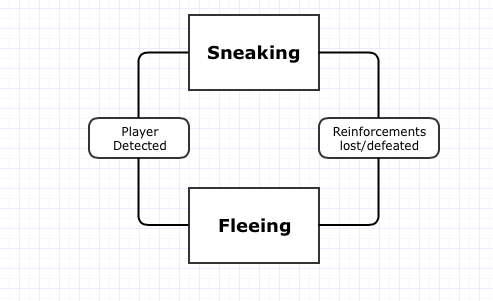
At least for me, the core joy of the stealth game is the playful movement through a wide possibility space for emergent player expression. Mastery of stealth game systems bestows new, creative ways for players to solve levels. At the heart of the stealth game is a simple game loop between two cognitive states. These states are:
o Sneaking: Player is undetected and is traversing to the level’s goal, while avoiding enemy detection.
o Fleeing: Player is detected by the enemy and must survive until she triggers an event that returns the game to the Sneaking state.
Core Game Loop
Players have access to the same verbs in both of these states, but are asked to use these verbs in different ways depending on their current state. This core, Sneaking-Fleeing loop is supported by a number of subsystems and properties that allow for that high degree of emergence. These subsystems and properties are:
The Multiplicity of Grunts
Overpowered Player Character
Level Design that privileges traversal.
GRUNTS
Every combat-oriented game has enemies that inhibit player progression and must be dealt with violently or otherwise. Stealth games are distinct from other action games in that their enemies pose a very different type of challenge than their counterparts. Typically, individual enemies in action games pose little threat, and encounters are designed to use a combination of enemy types to encourage a certain style of combat. Enemies in stealth games fulfill a very different purpose, and operate alongside the levels that they populate to create puzzlelike traversal challenges.
Whereas typical enemies use an “aggro-circle” system, guards have lines of sight, any area falling within a guard’s line of sight is threatened, and if the player enters this line of sight, they enter the “fleeing” state. This line of sight isn’t hardcoded, and cover created by objects in the environment alters this line of sight, allowing for safe-spaces to exist inside the line. Alternatively, players can use camouflage to blend in with their environment, making each guard’s vision-line much smaller.
Mike Bithell’s Volume
Guards typically have three AI-states, which operate alongside the larger gamestate, but on an individual level for each instance of the guard based on player-action. These states are:
Idle: Unaware, patrolling predetermined paths. (Sneaking state only)
Searching: Enemy unaware of player, investigating source of sound or distraction, altering line of sight to affect a certain area. (Sneaking & Fleeing States)
Alert: Enemy actively hunting down player. (Fleeing state only)
Forcing an enemy from the idle state to the searching state is one of the most important skills that players can master. By throwing a noisemaker at a certain area, players can mislead a guard towards a different part of the level, altering their line of sight and permitting the player to pass through an area undetected. Enemy AI must be predictable enough for players to exploit and manipulate these properties.
Players may choose to fight these enemies while in the Sneaking state, using items like silent guns, grenades, and tripwires to advantageously defeat enemies from afar, or sneak up close to preform a stealth takedown. Eliminating guards, lethally or nonlethally, reduces the total number of lines-of-sight patrolling an area, making it overall safer to traverse a level. Violent confrontation of these guards is typically a less-optimal strategy, and pacifistic play is usually indicative of very skilled play.
Dishonored
Combat mechanics may also be employed during the Fleeing phase, where guards call in reinforcements to deal with the player. Loud, lethal options like assault rifles are available to players to deal with pursuing guards as an interstitial step to seeking a way to return to the Sneaking state. Some games like Batman may allow the player to violently defeat all enemies in a level this way, allowing players to choose to forgo stealth altogether.
PLAYER ADVANTAGES
While the core narrative of the stealth game is one of triumph in the face of disempowerment, very much one depicting an “underdog”, players still are afforded a number of advantages that allow them to overcome enemies outside of pure combat. I’ve identified four present in the games that I’ve studied.
Mobility
Hiding
Intelligence
Gadgets
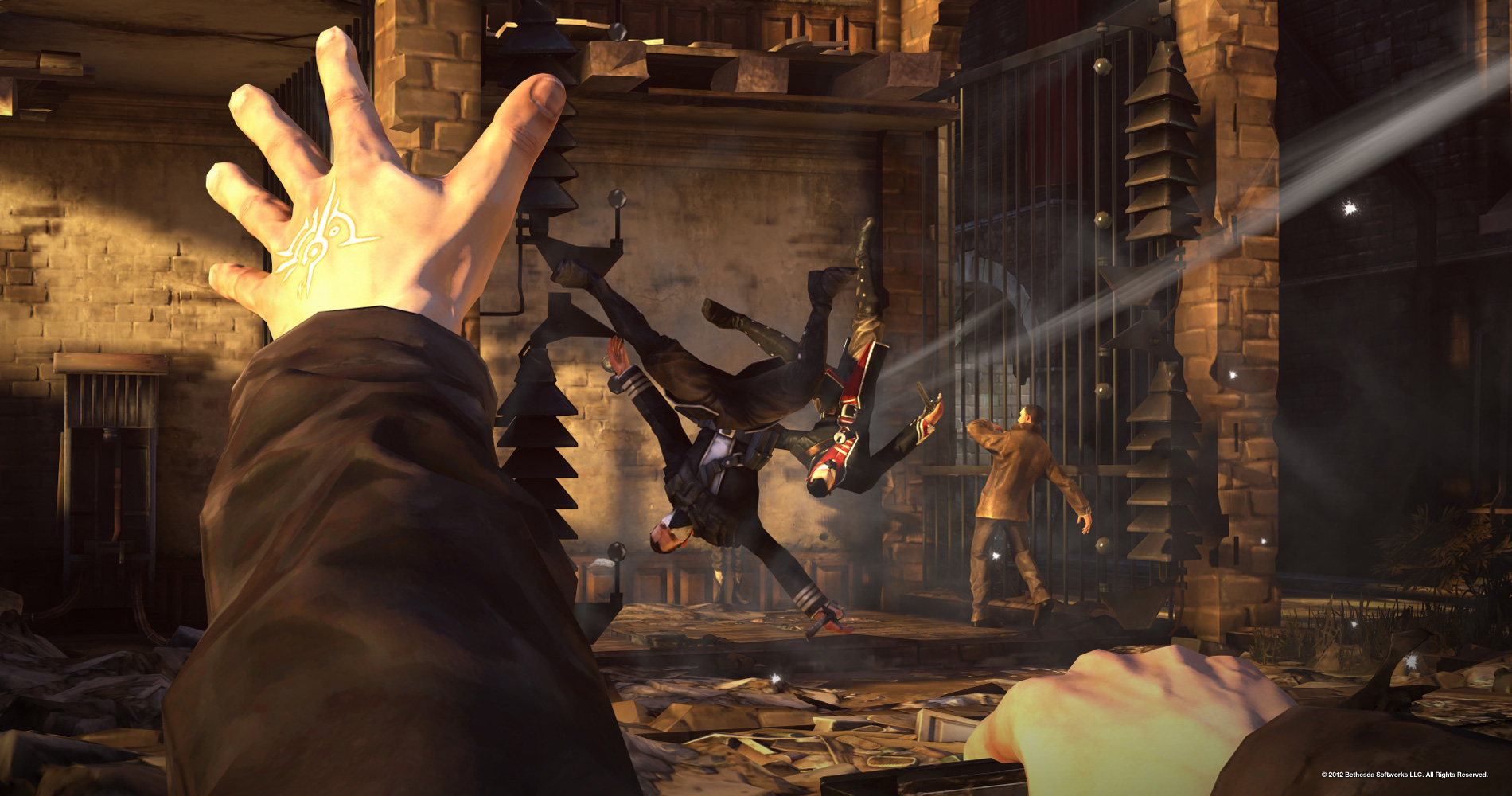
In games like Batman and Dishonored, players are given abilities that afford greater mobility, permitting access to parts of the level that guards cannot reach. Blinking onto the rafters or grappling up onto a gargoyle grants players a vertical advantage core to many of the more advanced strategies to their respective games. These advantages of mobility encourage players to make quick escapes and frantic, hit-and-run attacks. You may also notice that AI guards can very rarely crawl, and any time you’ve hid under a table or inside a vent, you’ve been exploiting an advantage of mobility.
Metal Gear Solid 3
Oftentimes, the player’s avatar has the ability to enter a number of different states that may allow him to be less detectable by guards. This can be as simple as the crouch ability from The Last of Us, to Metal Gear Solid 3’s colorful ecosystem of environments and camouflage fatigues. These changes to the player’s avatar reduce or alter the size and shape of the guard’s cones of vision, allowing for easier traversal through the environment.
Perhaps the most important advantage that the player can be conferred with is the advantage of intelligence. Simply put, the advantage of intelligence confers the player with a degree of knowledge over the current gamestate, revealing enemy positions, equipment, health, and paths. This allows players to strategically plan their movement around the environment, seeking out the path of least resistance. This advantage may manifest in systems like Farcry’s binoculars, Batman’s Detective Vision, or Metal Gear Solid’s SOLITION radar.
I put “gadgets” here with some hesitation because oftentimes, gadgets serve to facilitate the previous three types of advantages. Items like Splinter Cell’s snakecam afford intelligence, and Snake’s cardboard box confers a hiding advantage. Nonetheless, items and tools are a central aspect of these kinds of games, and searching for emergent uses from their combination is a central part of that joy of expression inherent to the genre.
SANDBOX LEVELS
I believe that by now we have established that the core goal of the stealth game is traversal rather than combat. Tactical movement through space ties the different approaches to stealth that these games may deploy, and completing a level feels more like solving a spatial puzzle than surviving a series of encounters.
To that extent, levels must be designed around the movement of guards and players through space. They must permit the guards enough space to threaten a significant portion of the level, as well as enforce deliberate and strategic movement through space on terms of the player. I am not a good enough level designer to identify the underlying threads that make good stealth environments, but I can identify a few common characteristics.
The Last of Us
Stealth game levels have a multiplicity of paths, allowing for players to feel a degree of authorship over their particular methods of solving levels. Metal Gear Solid 5’s Camp Omega is one of the best environments I’ve ever played in for this kind of design, and its opening minutes feature no more than four means of entering the base.
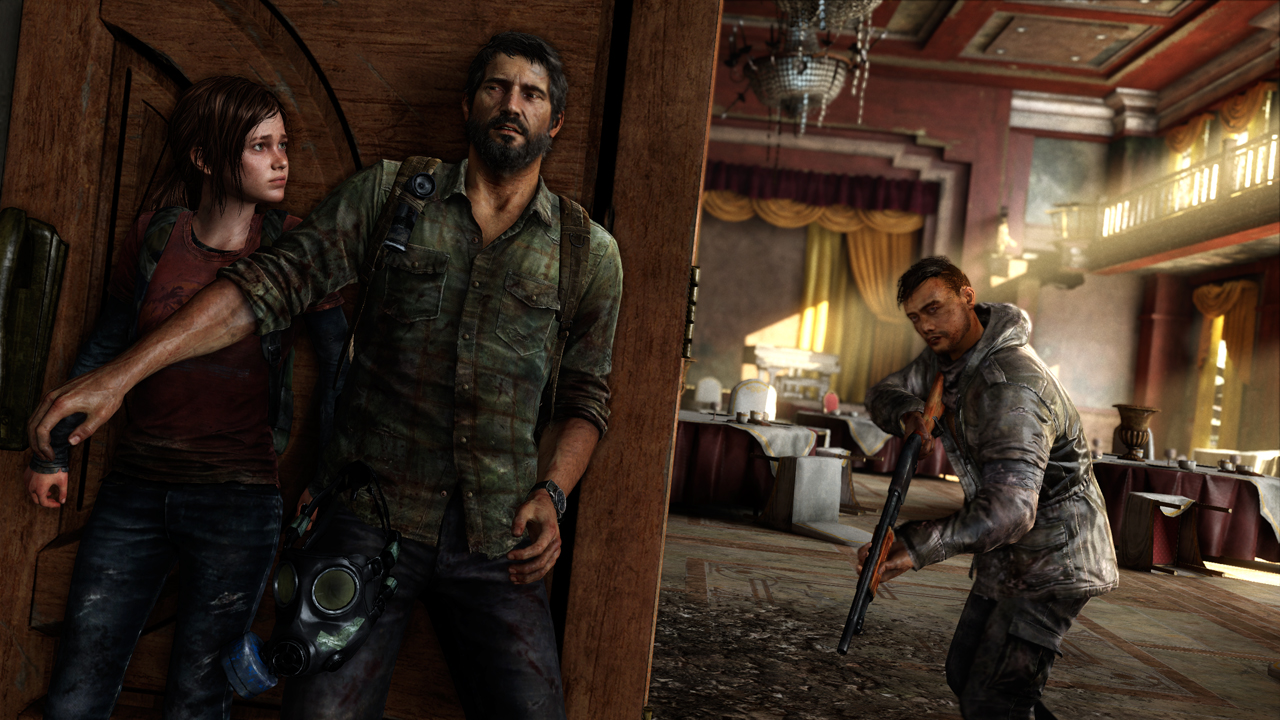
Cover, as I have stated before, cuts off enemy line-of-sight, creating safe spaces for players to stay in. The interspersal of cover, and its limited usefulness as guards move around it, creates an important rhythm as players dart in and out of it as they move to eliminate enemies and reach their goal. One game that I believe achieves in this regard is The Last of Us, which very deliberately distributes its cover to convey a sense of vulnerability for the player character, even after mastering AI manipulation and movement patterns.
Finally, stealth game levels tend to feature areas that only the player can access. Crawlspaces, drainage ducts, rafters, and ventilation shafts confer tactical advantages that guards lack. Dishonored did this well by prohibiting vertical movement for its AI guards, allowing for any raised, vertical area to be a potential safe-space as players blinked towards their goals, which were typically positioned to demand horizontal traversal.
I’M A NINJA
So that takes us back to our core loop of sneaking and fleeing, the movement between these two states is core to good stealth games. Weak stealth games tend to have poorly designed fleeing segments, leaving players without any options to compensate for their failures and effectively bring the gamestate back into the sneaking state, so designers of stealth games should strongly consider the affordances players are granted to solve problems in the fleeing stage. Instantly failing the player for being detected isn’t good design. There must be a way to absolve failure and move between the two states in the loop.
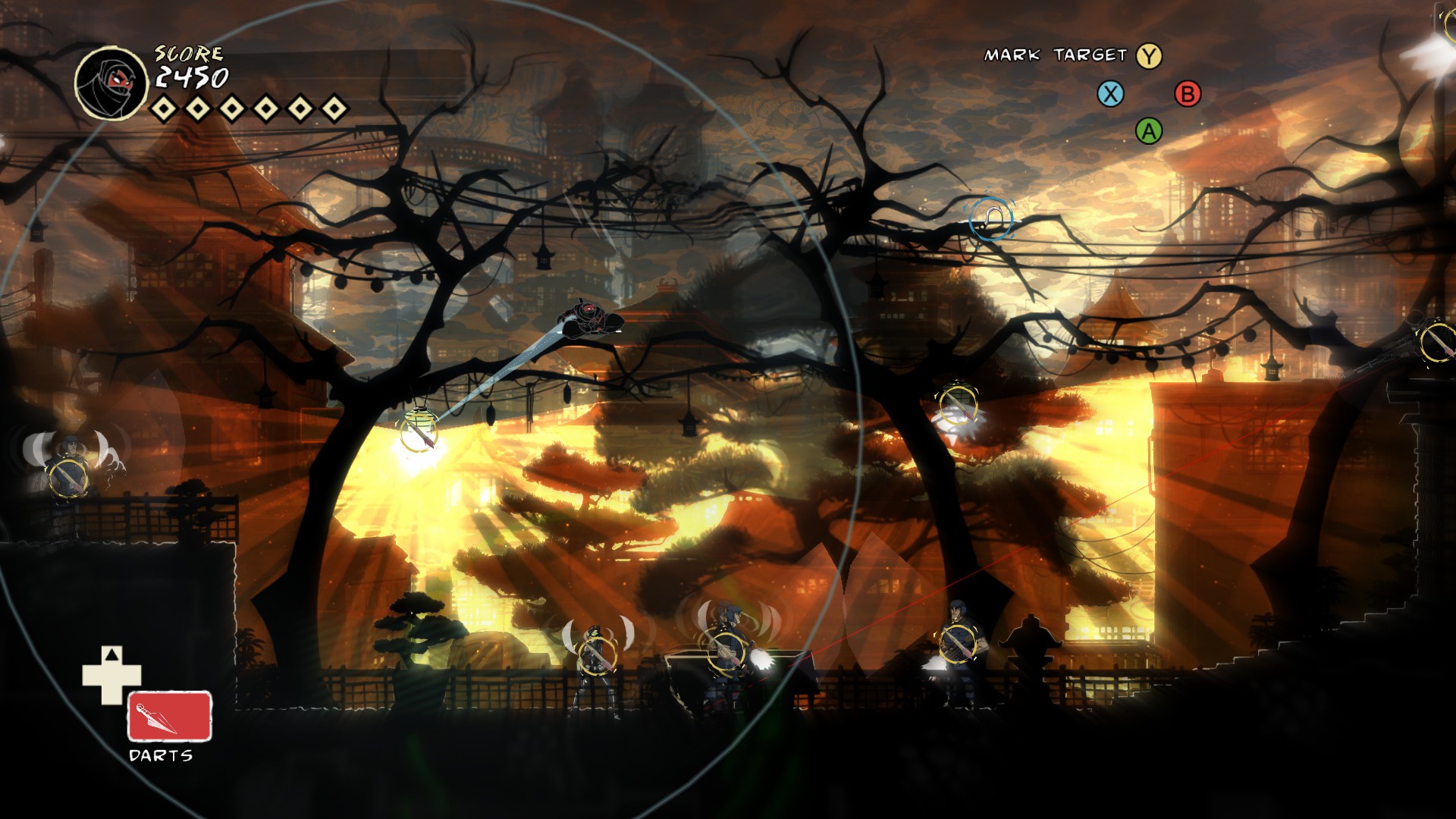
Mark of the Ninja
I write this moving out of a year of closely studying stealth games. I’m a huge Metal Gear fan and played a lot of hide and seek in my youth, so unqualified as I may be, I think I can make some general statements on what makes good stealth games. More importantly, I’m believe this knowledge would be fundamental to me as I move onto my next two projects, which are both stealth games.
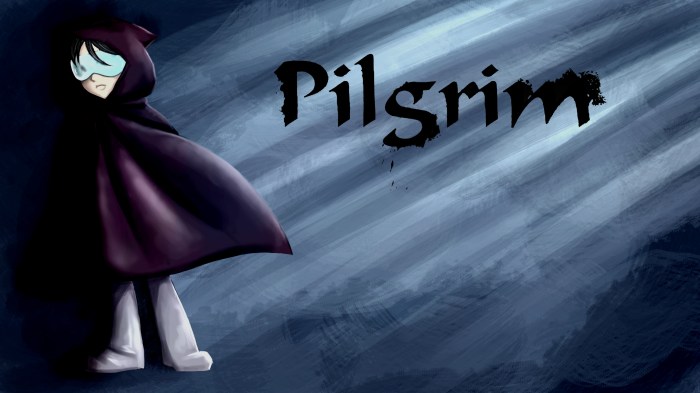
This postmortem was one of the hardest things that I’ve ever written. I’m good at clinical, analytical writing, but stuff like this is tough to put out and might not be well edited or clearly communicated. Nonetheless, this postmortem deals with my latest game, The Pilgrim, a short-form game codeveloped with Catherine Fox for Richard Lemarchand and Peter Brinson’s Intermediate Games class, a cross-country collaboration between USC Games and the Berklee College of Music.
The Pilgrim was originally intended to be a personal game about religion and my feelings towards it. Through mechanics and story, I wanted to deal with the courage required to have faith in uncertainty, the changes we must make to the direction of our lives to uphold ideals, and the sacrifices that we must take to back those convictions.
The first encounter in The PilgrimIn making this game, I wanted to come to terms with my own confusion, frustration, and hesitance over my agnosticism, as well as emphatically communicate through play those exact feelings. I believed that the medium and design that I chose was apropos for such subject matter because videogames, as Anna Anthropy states in Rise of the Videogame Zinesters, are uniquely capable of confusing and frustrating players.
Primary inspirations for our metaphorical mechanics were Thomas Was Aloneand Dys4ia, as well as Metroid: Zero Mission and Zelda, the latter communicate the monomythic hero’s journey narrative in their gameplay, and the former metaphorically utilize game feel to depict social systems.
Why I Wanted to Make it
In my nebulous understanding of it, religious faith requires adherents to make a lifelong sacrifice: the alteration of one’s life purpose to fulfill the ideals and tenets of a particular religion. It requires one to cease pursuing one overarching goal and start pursuing another.
Cutscenes were a late, post-beta addition.
My beliefs in my purpose on Earth are strong. My understanding of it has become my credo, it is the thought that I wake up every single day with, the dream that I work towards with every waking hour. “I want to be the greatest game designer”. My hesitance towards religious belief isn’t grounded in doubt of the existence of God or any higher power; my hesitance is grounded in the fear that I would have to alter that conviction. The idea of letting go of that purpose and living out any other one terrifies me.
Granted, that deluded dream has been problematic on a number of levels. The desire to be the very best has made me paranoid of failure and humiliation. I eagerly take on leadership positions and obsess over whether or not my team trusts and respects me. I’ve held passive-aggressive rivalries with some of my best friends at IMGD. These delusions have been responsible for a number of problems that The Pilgrim faced during its production, and as a student, I’d be better off without them.
The people I make games with.
And yet, a meme that you’ve ingrained into yourself every day for years is a hard one to unhand. To accept any other purpose as your own, religious in nature or not, is a tough sacrifice to make. Living for God and creed rather than aggressively giving games to the world, that’s a huge change in my life’s direction.
The sacrifices we make to fulfill our perceived purpose is the main theme of The Pilgrim. Hopping around the first level, feeling empowered may be fun to do, but that’s not what players must do to fulfill the overarching goal of the game, at least under the lusory attitude. In order to fulfill the Pilgrim’s purpose of descending to the bottom of the Temple and ousting the Shadow Beast below, players must choose to accept the sacrifices, their associated penalties, and the intentional frustration that comes from clunky and restrictive locomotion. Taking comfort in fulfilling their purpose in the gameworld, and leaving with different interpretations based on their life experiences.
The Pilgrim was valiant, but didn’t nail this goal precisely.
What went wrong
We ran into a number of production issues during development, the first came from the fact that both Catherine and I were juggling work on The Pilgrim with numerous other projects, including theses,pitches, and other demanding classes. Both of us were only able to dedicate a fraction of our time to the project and were not able to test or prototype as early or often as we would have liked. Up to the final hours of the project, we were making substantial changes to the game that we weren’t able to playtest.
Another issue that we faced was communication problems. This was largely my fault, as I would often work on my own and make changes without communicating them to Catherine. I often have a hard time listening when I’m working “in the zone”, and sometimes unintentionally forget or ignore suggestions made by my team members.
The earliest version of the first level was structurally very different from the end result.
These communication problems caused us to waste time in a number of ways. I spent two weeks working on a single visual effect that was ultimately cut. We weren’t able to playtest and get feedback as often as we would have liked. The game was intended to subvert and disrupt usability heuristics with intentionally frustrating and disruptive design, but we weren’t exactly sure how to quantify and observe that quality in our playtests.
Furthermore, my attitude towards the game would change frequently. Making something personal and introspective requires you to be in a certain mood, its difficult to create good work when you’re not in that introspective lethargy. Working on a four-month project, I was oftentimes outside of that mental state and had difficulty keeping motivated and maintaining the right vision for the project. Oftentimes, I would look at the game’s design and intentionality and hate it, feeling that it was the embarrassing byproduct of a transient phase of my life.
The game’s final encounter was one of the hardest things to design. At the end, the Pilgrim arrives in a dark corridor and must defeat the Shadow Beast. We were decidedly against creating an explicit combat encounter, as violence could detract from the game’s tone, but the limited range of player abilities restricted our options. We should have tested different iterations of the encounter, but lacked the time to experiment with stuff like AI, enemy projectiles, and complex level design. I’m still not satisfied with how the encounter turned out.
The game’s climax was an extremely difficult and rushed design.
I often feel that I’ve been selfish in making a personal game as a collaborative project. The themes of The Pilgrim were relevant to me as it was a game that I really wanted to make. Catherine holds vastly differing views from me, so I feel that I pulled her onto a project that wasn’t relevant to her life and used her help unfairly.
What went right
We responded well to feedback. While the game’s controls were designed to degrade into something clunky and frustrating, playtests would often indicate that they didn’t serve the game well overall. As a result, we iterated through three 2D shooting systems and rewrote major parts of the character’s controller. While I wanted to use game feel metaphorically to convey the story a-la Thomas Was Alone and Dys4ia, players still needed narrative contextualization to explain why they were becoming increasingly weak. We iterated between several dialogue systems before ultimately settling on traditional cutscenes and making our protagonist silent. The stairwell in the first room was one of the most difficult things to create, as it had to be traversable by the player at two different stages without taking up too much space in the environment.
The game’s audiovisual style also worked very well, lending the gameworld a distinct feel. One of the design goals for the game was to create something atmospheric and immersive, much like the action-adventure games of my youth. Adaptive sound design by Austin DeVries nailed that presentation, and Catherine’s moody, textured art and level design allowed us to succeed in our worldbuilding goals. Incidental assets populated each room, showcasing an explicit dramatic arc for the characters that lived in the Temple.
A cut feature would have populated the scene with hundreds of intelligent moving creatures ate up a lot of our time.
The interplay of light and dark is one of the most important aspects of The Pilgrim’s background, serving an important gameplay purpose in some of the encounters: being exposed to darkness drain’s the player’s health, thus, players must stay near light crystals to survive. The use of textured planes and cubes allowed us to exploit Unity3D’s realtime lighting system, allowing us to create a dreamy, surreal atmosphere that we wouldn’t have been able to achieve using self-illuminated sprites.
We both grew as game designers. Both of us took on tasks that we had never done before and learned much about different aspects of game-making. Catherine took up level design, character animation, UI design, and scripting. I took up programming and ended up doing more programming and scripting tasks than I knew I was capable of. While we faced issues in project management and didn’t polish the game as much as we could have, both of us are far wiser and better game makers because of it, and move on with a great deal more skill and confidence as we graduate from game-jam style projects towards more structured methodologies of production and distribution.
The takeaway
I don’t know if I delivered on the game’s vision and I’m not sure if making the game has resolved what I wanted to deal with in my own life. Yet, through all the problems we faced during development and the stress of juggling the Pilgrim with other demands in my life, I must say that the project was an overall positive experience that I grew from.
I don’t think I’ll be doing an intensely personal game for the immediate future, as the projects screaming to be made in my journal are not artgames. The questions I went into the project with have yet to be resolved conclusively despite what progress I’ve made as a person.
An early control mockup from two months before production began indicated overs coping.
Since we make art to make sense of reality and our place in the world, then I think I will return to The Pilgrim in the future. New life experiences will distill my perspective, giving me more to draw upon in crafting this microcosm of my reality. Tempered design skills will allow me to communicate with greater ludic nuance and grace. And life’s finite nature, and the infinite nature of the unknown, moots any hesitance towards game creation. I’ve grown from The Pilgrim, and journey forward onto new projects, people, and classes.
As I conclude this project, I would like to thank Peter Brinson, Richard Lemarchand, and Riley Piestch, who gave us the structure, support, and wisdom we needed to realize this project. Catherine Fox for her extraordinary patience and skill as we both went on this crazy journey. Austin DeVries for recording and mixing the game’s atmospheric soundscape and communicating with us remotely, and finally Steven Li for coordinating playtests and giving us the feedback we needed to make the right design decisions.
Some of you might know that I’m running a team for the 2014 Dare to be Digital competition, a nine-week international game design competition in Scotland. My team, Overly Kinetic, is comprised ofthe fantastic Esteban Fajardo, Catherine Fox, Alec Faulkner, and Tommy Hoffman, and our game is Chambara, a multiplayer first-person stealth-action game with too many adjectives in it. Check out the video pitch below to learn about it, because frankly, its actually really hard to describe it with words.
So in a nutshell
First-person stealth deathmatch game for PC
Dichomatic aesthetic: hide in plain sight
Local multiplayer
Pitching for the 2014 Dare to be Digital Competition
But Chambara can’t exist without your help! While Dare to be Digital will provide the tools, room, and board to allow us to produce the game for the Protoplay festival in August and compete for the coveted Ones to Watch BAFTA, competitors are still responsible for getting themselves to Scotland, which is a thing that we will need to turn to you to accomplish. We’re running an Indiegogo campaign to fund this journey, which you can access here. If we don’t get into the competition, the raised money will be donated to the Child’s Play Charity.
Here are the rewards that you can get for pledging:
$10 – Credit in the finished game
$30 – Credit, full digital game & personal thank-you card
$50 – Credit, Chambara Poster, full digital game, & personal thank-you card
$100 – Credit, Chambara T-shirt, full digital game, & personalized thank-you card
$300 – Credit, Chambara T-shirt, Chambara poster, full digital game & personalized thank-you card
So if you’re interested, head on over to the crowdfunding site and pledge to the project!
It’s been forever since I last updated this blog. I’ve had plans to do some in-depth articles, specifically an in-depth analysis of the Metal Gear Solid series and a personal essay about my story and how I ended up doing games, but life has the tendency of getting in the way of unrewarded stuff that I really want to do. Topics worthy of discussion spring up and evaporate like springtime flowers, and stuff like Flappy Bird, Twitch Plays Pokemon, GDC 2014, and this weekend’sGAME_JAM controversy. But alas, I’ve found myself working pretty much every waking hour for the past two months on a number of projects.
Videogame Bookclubs
Bookclub?
I’m giving talks and leading discussions now. Working with MEGA, the game developer’s club at USC, I’m running a monthly series of salons where people can come in and discuss contemporary games from thematic, design, narrative, and aesthetic standpoints, the format of which I’m basing off the similar Playthink art/game salon. I’ve run three thus far, respectively covering The Stanley Parable, Twitch Plays Pokemon, and Papers, Please, and each of them greatly exceeded expected attendance, making for very lively, often packed discussions. I’m planning on running for MEGA’s staff elections at the end of this week, so come out to SCI on Friday and let’s plan fun stuff for the next year.
The Observatory
I’m running playtests for a Master’s thesis project at USC, working in a dedicated observation lab, I record feedback and player behavior in hopes of improving Logan Ver Hoef’s thesis: The Observatory. I’ve run playtests before for intermediate projects, but this one is particularly interesting because it deals with game feel and environmental narrative, two things I’m very interested in learning about and deploying in my own games.
The Maestros
Maestros
I’m handling website content for The Maestros, a competitive online RTS-deathmatch game being run this year as an Advanced Games project. The game is currently in public alpha, and you can easily download a build of the game, create an account, and begin playing immediately. The game’s core narrative is a bit uncomfortable for me, exploring themes about violence, imperialism, and its ideological ramifications through its mechanics, and maintaining websites and reaching out to the press isn’t what I’m interested in doing with my career, but I’m glad that it has been immensely successful, right now, its one of the most polished games to have ever come out of USC.
The Pilgrim
The Pilgrim comes from an original design document I wrote late last December. It was a very personal game dealing with religious belief and the life-compromises that observing those beliefs predicate, something that I’ve considered in my own life for years. This narrative would be delivered through an inverted-Metroidvania narrative, with the player surrendering powers and abilities to fulfill her purpose and complete the journey through an abandoned mine underneath a Temple. Teaming up with my good friend Catherine Fox, I decided to make the game my project for Peter Brinson and Richard Lemarchand’s Intermediate Game Design class.
The Pilgrim
I learned more from this ongoing project than from any project I’ve done before, except for perhaps Dark Deception, a RPG system and campaign I ideated back in high school. Working on the project as part of a two-person team, while coordinating external testing and audio, I dealt with more scripting than I’ve ever had before. We also dealt a lot with scoping, and The Pilgrim shrunk from a short Metroidvania-styled adventure to a short-form platformer/adventure game more resembling the mountain scene from Journey, with the avatar becoming increasingly feeble and hard to control as she progressed towards her goal.
I hit a few major hitches while working on the game. I became very sick one week in early March, causing me to lose an entire week from our production cycle, forcing me to crunch later on. I also spent two weeks prototyping myriad versions of a single feature that was ultimately cut due to performance issues. Communication with the rest of the team has also been a challenge, and making sure that everyone was on the same page and understood our vision and codebase has been something I’m not personally satisfied with, having blocked off progress from other team members by not communicating well. A rough project, but one that I’m glad to have undertaken.
FROM WITHIN
From Within
I ran into my CTIN-488 TA, Jesse Vigil, late last week, who was impressed with my team’s final project and suggested that we submit it to Indiecade. I don’t think any of the digital games in my portfolio is festival-quality, but FROM WITHIN was an interesting and exciting project that I really enjoyed working on. It’s a party game for nine players meant to be played in eerily-lit basements around snack-laden tables. The mechanics are rather simplistic and exist to create intense dramatic tension and catharsis, contextualizing the rich social play of scaring and deceiving other players. I’m excited to get my team back together to revise the game for submission come this May. If anything I’ve done is festival-quality, its definitely that game.
Secret Scotland Project
This is a project that I’m excite to work on. I’m working with a small team of some of my best, most talented friends to pitch a game for Dare to be Digital, an international game design competition in Scotland. If we get accepted, it would be the single greatest game design challenge that I’ve ever faced in my life, but also the most exciting. We’re super-eager to work on this game, and the prospects of traveling to the UK to compete on the world stage for a BAFTA is thrilling.
The sixth 48-hour Global Game Jam starts January 24th, and I can’t be more excited for it. I treasure the memories of the panic and the productivity, the initial minutes of confusion as we stumbled around trying to come up with an idea around the theme, and the exciting escalation as the mist cleared and our game idea came into being. The empowering feeling of making something with nary a clue what I was doing, and the electrifying flow of caffeine through my veins.
My team from my first Global Game Jam.
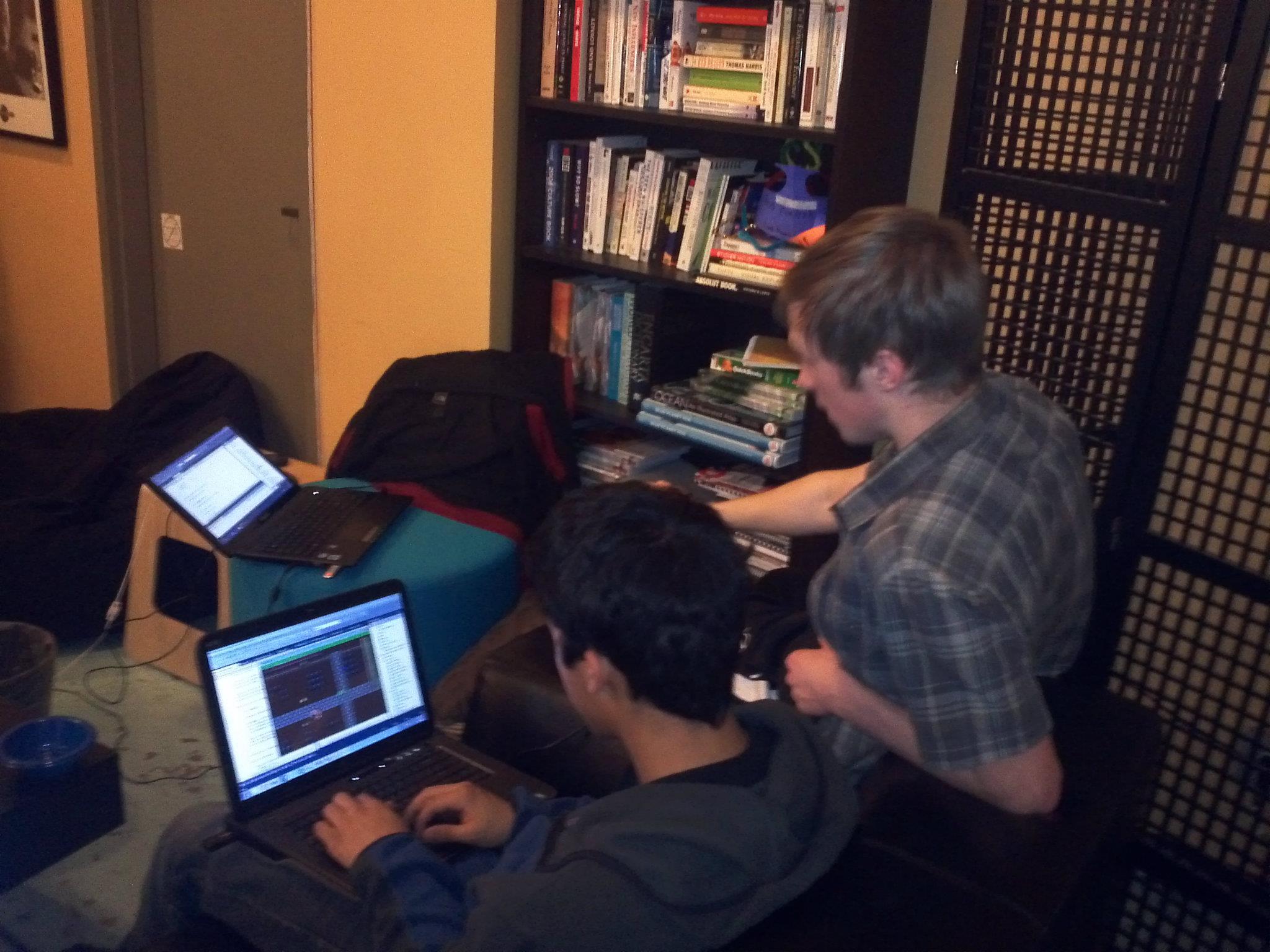
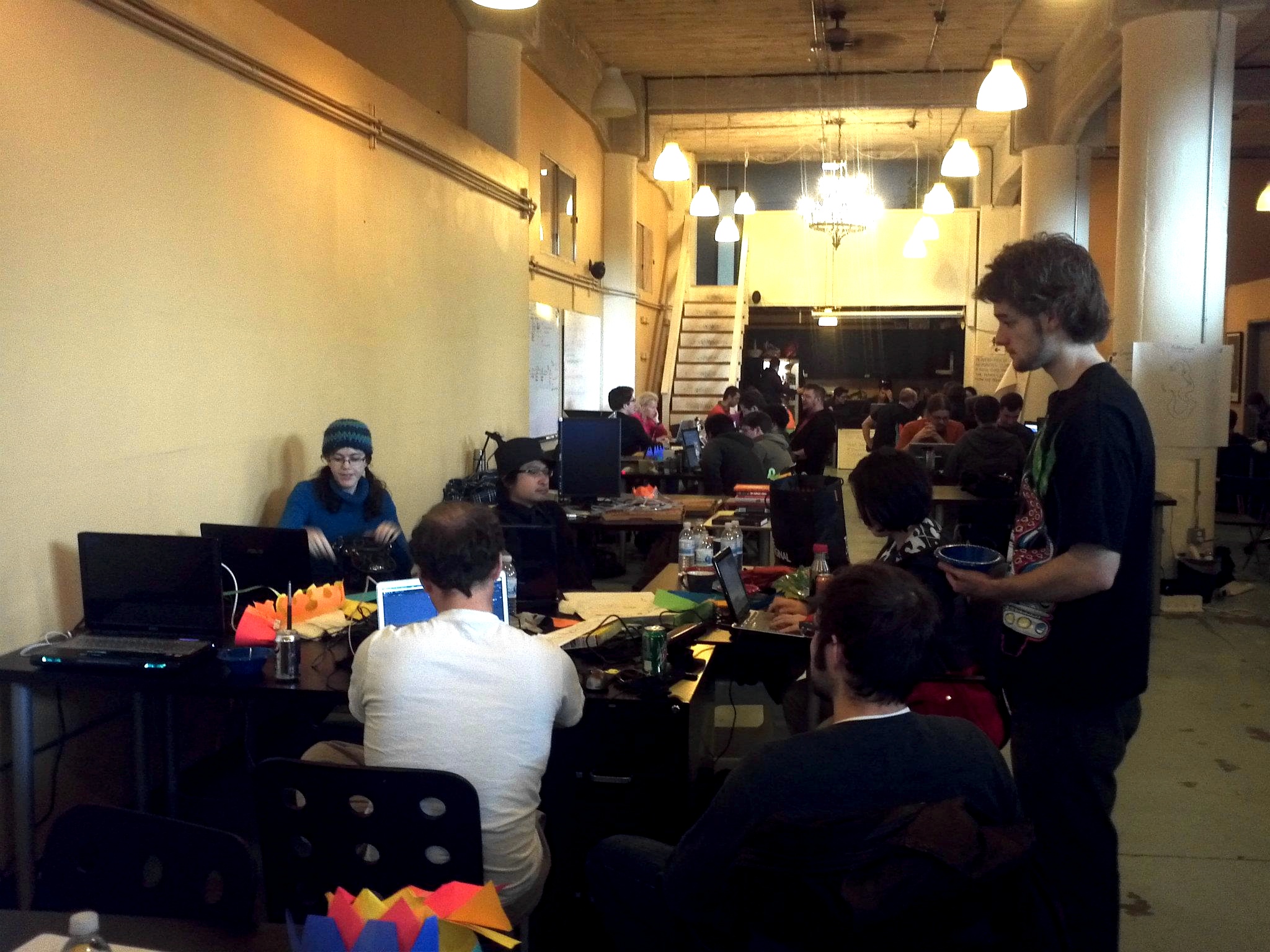
I remember jamming with Xander and Bard, the looks of the other developers at Citizen Space as they peered over at us every time a zombie screeched and the day we exhibited our game at Mr. Grant’s AP Comp Sci class. I remember that weekend with Catherine and Esteban, as we munched on thin-crust pizza and wrote Processing code, surrounded by LA’s most renowned indies. And those magic hours in the early morning, as we giggled like sleep-deprived schoolchildren at silly Italian Spiderman puns and our game evolved from The World’s Heartbeat to Unhearted, culminating in a delightful surprise we left just for our judges.
So, yes, I’m getting a bit sentimental over my Global Game Jam memories, but I’ve good reason to do so: the Global Game Jam is a magical weekend filled with delightful stress and love. For an aspiring game developer, there’s no better place to gain loads of experience and have a great time doing so. Here are nine reasons why it is the best non-professional gaming event of the year.
1. It is fun.
Play is an act of volition undertaken for its inherent value to the individual, whereas work is a compulsory act undertaken for an external motive. Creation can be either, but both academia and the industry tend to privilege the latter due to professional obligations. Game jams exist purely to serve the former: game jamming is playful.
An image of Ouroboros was the theme for 2012’s Global Game Jam
The joy of making stuff is diminished when it is done out of a compulsive need to answer to an authority or meet demands. Participation in the Global Game Jam is voluntary, and you are free to make whatever you want without having to answer to requirements handed down from some disconnected arbitrator. At the Global Game Jam, you are free to create games simply because you want to, playing with tools and methodologies, rather than working with them. Given how structured and hierarchical media-making usually is, there’s not quite a better place for playful, subversive game-making.
2. A safe space to make crappy/weird games.
It is said that academia and indie development is a safe-haven for goofy and experimental games. This is not entirely true. Expectations of quality and polish inherent to classroom settings privilege projects that aspire to fulfill existing notions of “good” game design, leaving “intentionally bad” games without a place in traditional game design classes. Indie developers outside of the fringe still call their line of work a “job”, and thus must fulfill consumer expectations of polish and playability in order to be commercially viable for distribution on networks like Steam. Given the expectations of those settings, there is little room there for “crappy” games. What space then is there for the interactive joke? The Twine-based acid trip? The plastic-guitar controlled shmup?
Collaboration is a special kind of relationship. It requires one to assert exactly enough of their ego to invest themselves in a project and realize a strong vision, but it also demands that one reel back and allow others to express themselves through your idea by modify, tweaking, and editing it. A collaborative relationship is not an unilateral one, with one individual dictatorially demanding his collaborators to surrender their dreams and individuality to realize his vision, but rather a multilateral dance between equally expressive minds. Each participant in this dance swerves back and forth, gently pushing their ideas forth while gracefully gliding back to let others do the same.
Collaboration at its best is fuel for true friendships. I loved my board games class last semester not just because of the excellent lecturer, but also because of the project-based structure of the class. A new game was due practically every week, and groups were assigned randomly. The high-pressure environment of the class and the free flowing, improvisational nature of the projects fostered a collaborative relationship with my classmates, and I probably made more friends in that class than I have in any other non-games class.
The Global Game Jam promotes precisely this kind of mutuality. If the sappy reminiscing above tells you anything, its that those 48 hours made me close friends with the people I chose to jam with. Collaboration is not always so perfect, some may overzealously assert their vision while others might panic under the pressure, but the shared experience of watching something awesome unfold out of your combined doing is deep and moving.
4. No prerequisite knowledge.
There’s this unfortunate stigma surrounding game development that intimidates a lot of newcomers away from it. A narrative exists that game-making rewards only the best autodidacts, that the only way one can get experience in making games is by making games, leaving many people lost and confused as to where to start. Some may join indie or student projects, but given that hierarchical structures and standards of quality still exist with those groups, its easy for newbies to feel lost and confused when trying to participate in those teams. That’s assuming that those groups welcome newbies at all, the student projects I’ve seen at USC have become increasingly competitive and exclusive, demanding too much from confused beginners simply looking for stable ground to grow from.
Unhearted was coded with only loose understanding of Processing.
At the Global Game Jam, the only barriers to entry are mental. If you know Photoshop, then you’re the artist. Know how to use Audacity? Sound designer. Basic familiarity with C#? Programmer. Its easy to feel intimidated in the face of such responsibility, but the feeling of agency over how you want to do things is empowering, and that courage and confidence will carry you far further than any mentor can.
5. Learn new skills.
This is a big one. The Global Game Jam is not a competition, but rather a social gathering where people come together to make games, everyone wants each other to succeed. There will be numerous experienced developers there, and the communal nature of the event encourages people to share ideas and teach tools and skill to each other. The diversity of the people who come out to these events guarantees that you’ll be able to find at least someone to teach you the secrets of any given tool, be it Photoshop, Game Maker, Unity, or XNA. Collaborate with at least one very experienced jammer, and you’ll come out a far better game developer than you were before participating. For an aspiring game designer, there’s no better place to make your first game.
The 48 hour time limit helps too. In any other setting, it is easy to slack off after watching tutorials and not put anything you learned to practice, making autodidacticsm basically useless. The expectation for one to complete a game by the end of the weekend forces new jammers to put what they learned into practice immediately, and thus, inexperienced jammers learn important skills here faster than anywhere else.
6. Perform under pressure.
Orson Welles said that “the enemy of art is the absence of limitations”, and in my experience, this is true. Limitations and conditions force me to think creatively to overcome challenges. Reality Ends Here‘s card-based prompt system and refusal to provide equipment exists to create these interesting limitations, and has caused its players to generate a wealth of fantastic work.
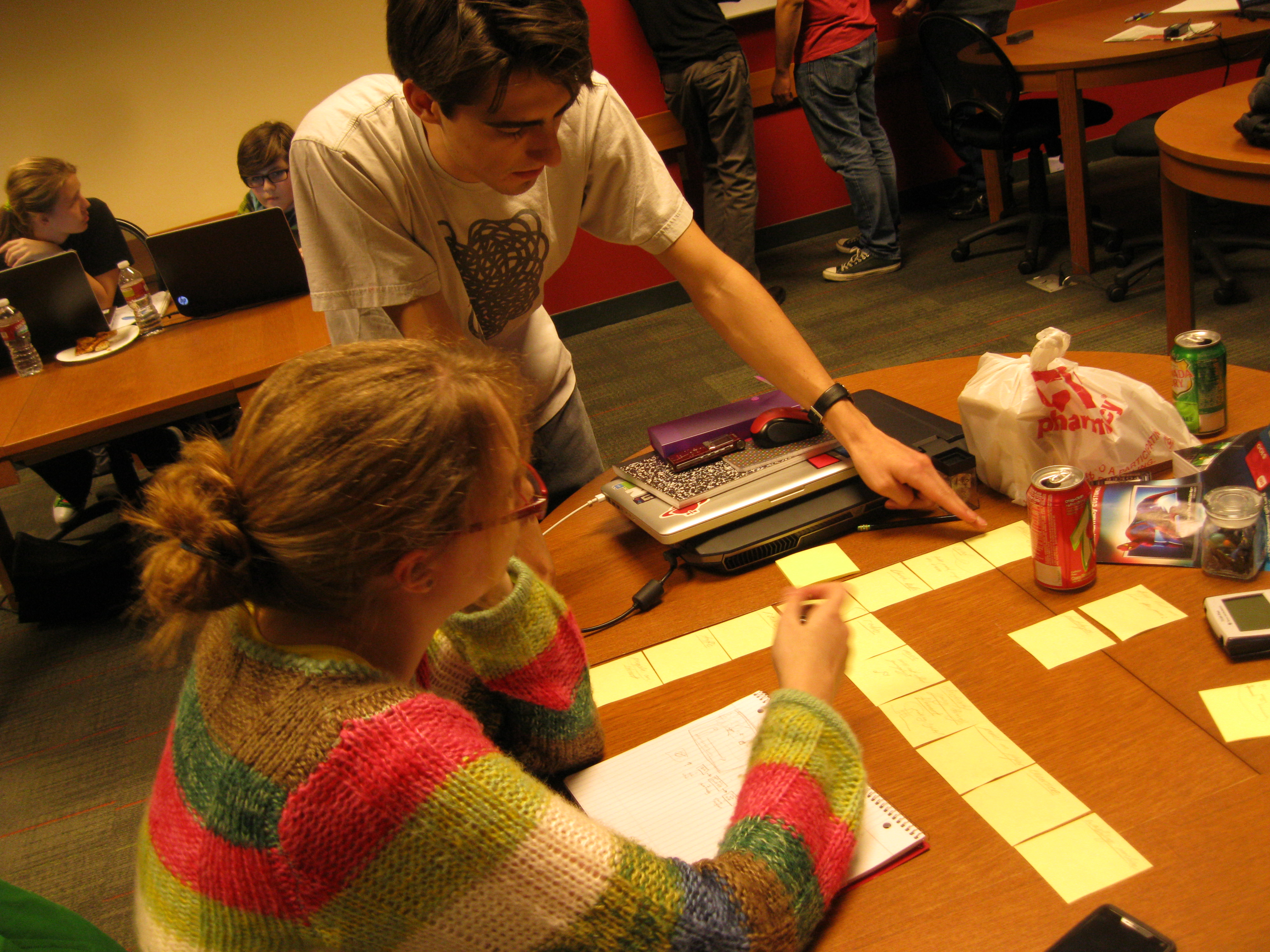
Paper prototyping Unhearted
When that digital gun goes off at 5 PM that evening, the first thing you’d probably feel is panic. Don’t. The 48 hour time limit serves to promote creativity, and a well-scoped, well-thought idea, executed well will come to fruition by the end of the time limit. Learning to work well under pressure will make you a better creator. You’ll face similar pressure everywhere in life, a game jam shouldn’t be anything different.
7. Overcome your fears.
Starting off a new game project is an intimidating process, one look at that blank programming slate and imagining how it will evolve into a full-fledged game is scary, and collaborating with others brings its own set of challenges. Am I good enough to participate in this jam? Will I drag my team back with my relative inexperience? Will my team think I’m incompetent? Am I even capable of making games? Maybe I should come back next year when I’m more ready. These mental barriers are enough to dissuade a beginner from making games, and the repetition of these excuses is enough to kill a great career at its birth.
Citizen Space, the venue for my first Global Game Jam
There is only one kind of fear: the fear of the unknown, pretty much anything else is imaginary. It might take a lot to step up and take the plunge, but the relief of seeing those fears dispelled is incredibly empowering. If anything, you’ll prove to yourself that you are fully capable of making games. Internalizing that notion can change the direction of your career entirely, and that courage and initiative will take you far.
8. Being part of something great.
The Global Game Jam is the largest single game creation event on Earth, generating over three-thousand games over the course of two days. It set Guinness World Records for largest game jam for the last two years, and looks to do so again this year. Simply by registering for the jam and coming out to the jam site, eager and intent to make a game, you’ll be counted amongst those 13,000 developers who have come together to participate in this incredible event. How many other opportunities to set world records does life throw at you? Passing up participation in the Global Game Jam will just be a missed opportunity.
9. Make a game.
By the end of the Global Game Jam, you will have made a game. You would have accomplished what most of society can’t. There are so many people out there who wish they could make games, but don’t. Just by participating in the Global Game Jam for its entire duration, you would have done what many people only wish they could. The fear of failure is too paralyzing for most people to endure, and by participating in the Global Game Jam, you would have transcended that fear. The vast infiniteness of the unknown demands pioneers unfazed by questions of success or failure, and by taking those brave steps into it, you would have done for the world a great service. Now that you have completed one small game, what’s going to stop you from doing so again, and again, and again?
This is the annual post where I basically go through all the notable and interesting games I played this year, wax poetic about them, and create new forms of hyperbole to describe my personal games of the year. Last year’s post can be found here, and previous year’s posts can be found on my high school blog, which I’m keeping hidden for all the reasons.
2013 will be remembered for two major movements within gaming: the rise of the American e-sports scene, and the proliferation of the queer games scene. I don’t belong to either of those scenes per se, but their growth is cause for celebration: the diversification of scenes to include people outside of that mainstream “gamer” community means that more and more people will become “gamers”, which is what I’ve always wanted. I hope to see soon a world where there will be a scene for every imaginable type of person, and I believe we’re making strides in that direction.
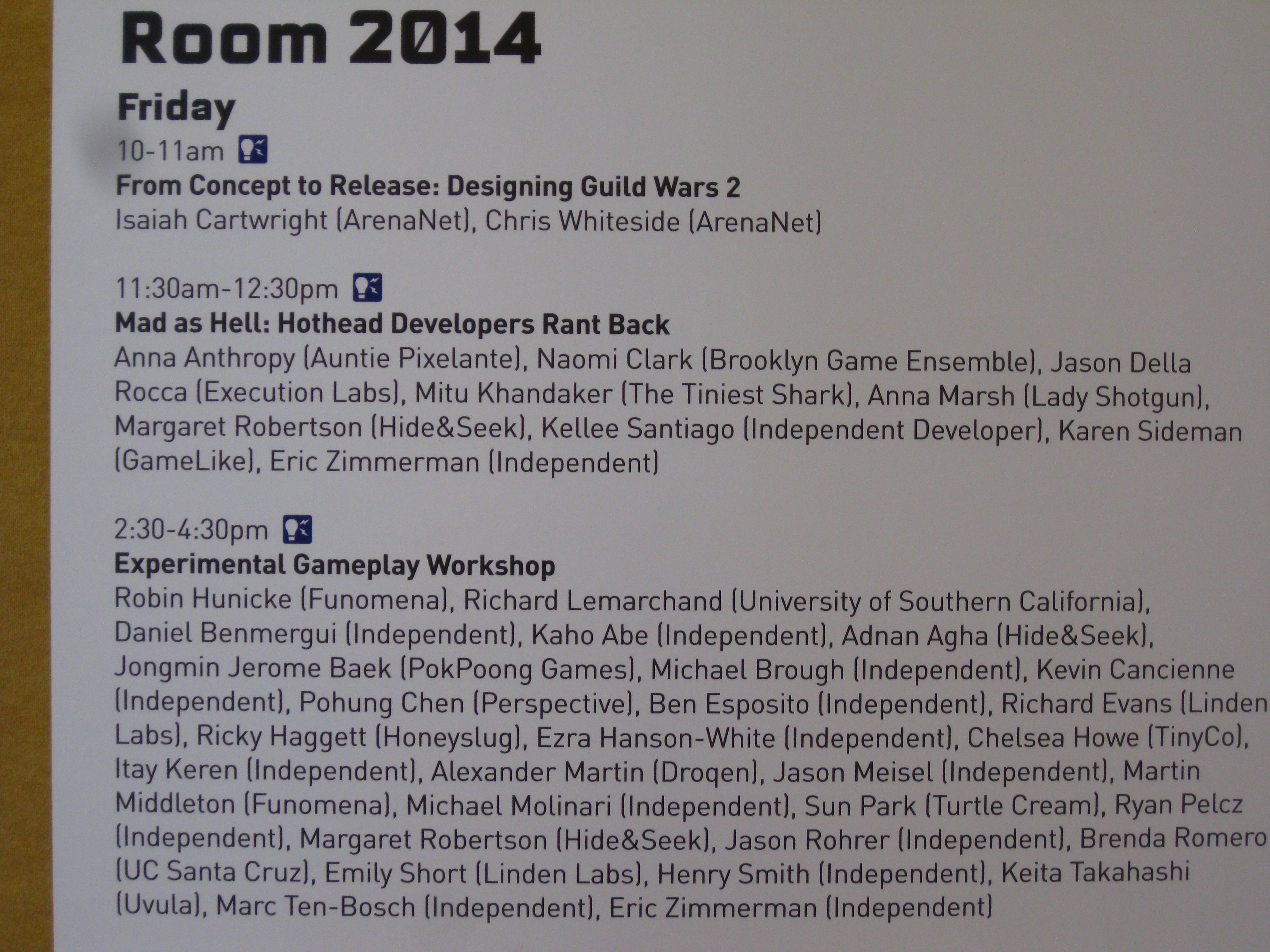
What transpired in Room 2014 at 2013’s GDC will be important in years to come.
Just a year ago, we entered a period of unprecedented change to how games are made, processed, and understood, leading to the proliferation of newfound developers, genres, subject matters, and modes of play. Now, that trickle of change has grown into an avalanche, and the game industry that exists today welcomes with open arms games like Surgeon Simulator, Gone Home, and The Stanley Parable.
Five years ago, the thought of a world like this would have been unimaginable.
Meditating on change in the industry, the importance of our place in time, and the potential we now have to steer the course of gaming’s destiny is something that I’ve done in previous posts, and really, I’m just repeating myself here. But I can’t help but reiterate my enthusiasm: this is the gaming world that I’ve always wanted to live in. In 2010, I yearned for more daring games unafraid to try something different and interesting, and in 2013, those games exist everywhere I look.
DEAD GAMES WALKING
Telltale’s hit point-and-click adventure The Walking Deadwas the first game that I played this year, and one of the most emotionally taxing games that I’ve ever played. Its a story-driven game about leadership, the core mechanic of navigating dialogue trees is contextualized in a way that every decision carries great ethical weight, asking players questions not like “what is right or wrong?” but rather “who do I want to hurt least?”. Telltale manages to maintain this sense of constant heft and weight throughout the game’s five episodes, concluding in a cathartic, heart-wrenching ending that left me drained, shaken, and worn.
Shadow of the Colossus
Next was The Unfinished Swan, a game by USC IMD alums Giant Sparrow, a first-person puzzle game that iterates upon its core mechanic beautifully. The Unfinished Swan is videogame comfort food, it’s a heartwarming, homey tale that makes you feel all warm and fuzzy and loved inside. As I played this game with my friends, I couldn’t help but subconsciously maintain a splendid grin throughout the entire experience.
Shortly afterwards, we played through Shadow of the Colossus, a monumental achievement of the sixth console cycle, which holds up with remarkable grace. The vastness of the gameworld dwarfs the player’s tiny, insignificant avatar, imbuing exploration with a tangible sense of forlorn loneliness. The giants which walk the Forbidden Lands trot with a quiet, fearsome majesty. Each battle with a Colossus carries a hefty emotional arc, ranging from the apprehension of the approach, the confusion and panic of trying to discover the beast’s weakness, the empowering, triumphant thrill of learning that weakness, and the catharsis… then sadness, of victory. Incredible game, definitely an annual playthrough for me.
Surgeon Simulator 2013
Surgeon Simulator 2013 is the game most indicative of where we stand in the history of this medium today. Here, we have a game developed in 48 hours at the 2013 Global Game Jam, a series of once-underground game-making competitions. It was not funded not by publisher, nor Kickstarter campaign, nor grant money. Surgeon Simulator wasn’t even a good game by traditional measures of design, featuring an intentionally unintuitive control scheme, the game is in essence an interactive joke. By all prior standards of game funding and publishing, Surgeon Simulator 2013 should have been quietly forgotten amongst the hundreds of games designed at these events. And yet, through an unforeseen wrinkle in how this world works, Surgeon Simulator was reviewed higher, and sold better, than AAA sequels like God of War: Ascension, Crysis 3, and Gears of War: Judgement. Consumers are changing, and are now welcoming new games willing to challenge long-encoded standards of design, making room for games about butterfingered surgeons. Its an underdog story so glorious that it could have only happened by accident.
“X IS A METACOMMENTARY ON Y”
In March, Bioshock Infinite, a game which I had eagerly anticipated for years, finally came out. It was the week of GDC, and all my game studies classes were cancelled, so I completed the game in a day. While upon reflection, the game is brimming with design and narrative flaws so basic that it’s a wonder how it passed playtesting, I found Bioshock Infinite to be an enjoyable, albeit overhyped and subsequently disappointing, shooter. My enjoyment of it came mostly out of its uniquely postmodern subtext, which challenges the notion of meaningful choice and autonomy in story-driven games. My analysis of it, which got featured on Gamasutra, has become basically my only claim to fame.
Bioshock Infinite
Next up was the delightfulFEZ. Like many, I discovered FEZ through Indie Game: The Movie and was tightly invested in Phil Fish’s painful, triumphant, underdog story. FEZ was fantastic with its daring experimental structure and wondrous difficulty. FEZ’s obscure puzzle designs and interdimensional platforming harkens back to memories spent of school playgrounds, secrets and rumors of the Mew under the Viridan City truck and the Triforce chest in Forest Temple spread like gossip. FEZ is a game meant to be played in parallel with a good friend, sharing every delightful discovery along the way with childlike wonder.
I didn’t know what to think of The Last of Us when I first learned about it a year ago. A third-person action game set in the zombie apocalypse featuring an old guy and a girl seemed pretty unoriginal given Naughty Dog’s fantastic pedigree, and thus, I went into it with doubts. When I finally played it, I found it unique and incredible in a multitude of ways. Combat is disempowering, limited resources and a relatively underpowered protagonistlends the game a sense of dread and despair that gives way into a panicked chaos of gunfire, culminating in the cathartic release of survival. The game’s story, one of the strongest told this year, calls into question the social demarcations separation “us” and “them” and meditates on themes of love and sacrifice.
The Last of Us
Thomas Was Alonewas one of the cutest games I’ve ever played. It is both one of the best puzzle-platformers to come out of a scene rife with them and perhaps the best demonstration of gameplay-as-metaphor and the proceduralist aesthetic to have come out this year. The way it characterizes its quadrilaterals and lends them personality through kinaesthetics and functionality elevates this puzzle-platformer into a delightful story about friendship, jealously, need, and identity. Thomas Was Alone’s rectangles undergo entire character arcs with meaningful conflicts and conclusions, and the game communicates those arcs through simple game feel, lending its characters a humanity not seen in all the dialogue trees and facial animation systems developers have produced thus far.
GO HOME
I disliked Metal Gear Solid when I first played it, but decided to give the series a second go after studying writing about postmodernism, a cultural aesthetic that the series adheres to very much. Metal Gear Solid 3: Snake Eater, which sheds the series’ cyberpunk postmodernism to focus on a Cold War-era spy fantasy, changed my perspective on the series substantially. A delightfully Japanese pastiche of 20th century spy fiction, Metal Gear Solid 3 is perhaps the most restrained and grounded game in the series (which is not saying much given Kojima’s predilection for vampires, cyborg-ninjas, and the Illuminati). Every room in Snake Eater‘s vast world is a playground for emergent strategies for traversal, coupled with a variety of tools from guns, to chloroform rags, and alligator hats, Metal Gear Solid 3’s sneaking system is an incredible sandbox for self-expressive play.
Gone Home
Standards for environmental storytelling have shot up over the course of the generation. Flavor text that was communicated by pressing the “interact” button next to an object is now communicated visually, through intricately detailed 3D models in a gameworld. The juxtaposition of objects creates place and story, and narrative discovered rather than delivered. This made traversal through the beautiful environments of The Last of Us, Bioshock Infinite, and Metroid Prime a delight, and it is wonderful to see a game like Gone Homeemerge from this burgeoning tradition. Evoking nostalgia for the nineties, Gone Home communicates a tale about a family that underwent a great change while its older daughter was off at college. The means of progressing through the story is snooping through the spaces each family member inhabited. Characters go through entire character arcs as the player creeps down a hallway, the catalysts for their change evident in the things they carried. Its a tough game that dances in and out of some uncomfortable themes, many of which strike close to home, and one of the most structurally interesting games of the year.
On the complete opposite side of the gaming spectrum, XCOM: Enemy Unknown consumed a substantial amount of my time early in the semester. Its an incredibly difficult, incredibly addictive turn-based strategy game that maintains a constant sense of desperation in every aspect of its design. The dread can become overwhelming as players become strapped for time, resources, and personnel, lending dramatic weight to every single decision. The death of a single high-ranking soldier from a stray bullet can cause entire plans to crumble in an instant. But when the dice land in one’s favor and a plan goes perfectly as intended, the triumphant rush of victory is unparalleled.
Kentucky Route Zero
Kentucky Route Zerois surreally magnificent, and maintains a consistency of vision that bleeds into every single corner of its dreamy aesthetic. It is a magical-realist point-and-click adventure game with art inspired by late 20th-century theatrical set design and poetic writing imbued with a nostalgic sense of Americana. It’s as if Steinbeck’s sentimental prose met the magical wonder of Rudolfo Anaya’s, creating a spiritually evocative tale of Conway’s journey down the Zero’s rabbit hole. For anyone even mildly interested in the unusual, Kentucky Route Zero‘s whimsical and forlorn world is one worth exploring.
Personal Game of the Year
Naming a personal game of the year is a substantial ordeal for me, simply because I feel a sense of guilt for overlooking all the great games that I considered for it, especially in 2013, a banner year for unusual and interesting games: digital, physical, analogue, and installation. And in the shadow of that regret, I must name The Stanley Parable as my personal game of the year.
Yes, systemically speaking, The Stanley Parable might not even be a game, academic standards of language and game studies considered, it fits more under the umbrella of interactive fiction than videogames, but that’s beyond the point. The point is that The Stanley Parable is interesting.
The Stanley Parable
If Bioshock Infinite called into question ideas of the existence of autonomy in an authored piece of fiction, then The Stanley Parable takes that metacommentary to its intellectual extreme, calling into question ideas of player motivation, narrative structure, meaningful choice, the lusory attitude, the player-avatar relationship, freedom in authored fiction, and the conflict between player and designer. The game posits those questions in short, fifteen minute bursts that demand reflection and study, performing its commentary more elegantly than Ken Levine’s bloated, frustrating shooter ever could.
Look, the core mechanic of the Stanley Parable is making binary choices to influence the outcome of a story, which in itself isn’t very interesting, essentially being tantamount to any number of terrible dating-sims. But when contextualized with questions about narrative structure and game design, The Stanley Parable‘s mechanics become ironically rife with meaning, evolving into the catalyst for engaging conversation. While many may rightfully criticize The Stanley Parable for not being a game per se, that does not make it any less interesting as a piece of interactive media, and in a period where all we’re asking for are games that take daring risks, engage with challenging themes, and are in essence unique and interesting, isn’t The Stanley Parable exactly what we wanted?
All of these games were designed by either myself or a small team of co-designers over a series of three-week sprints. Click to download printable game files.
Codesigned with Max Cohen, Aamod Walavalkar, and Sarah Jennisca.
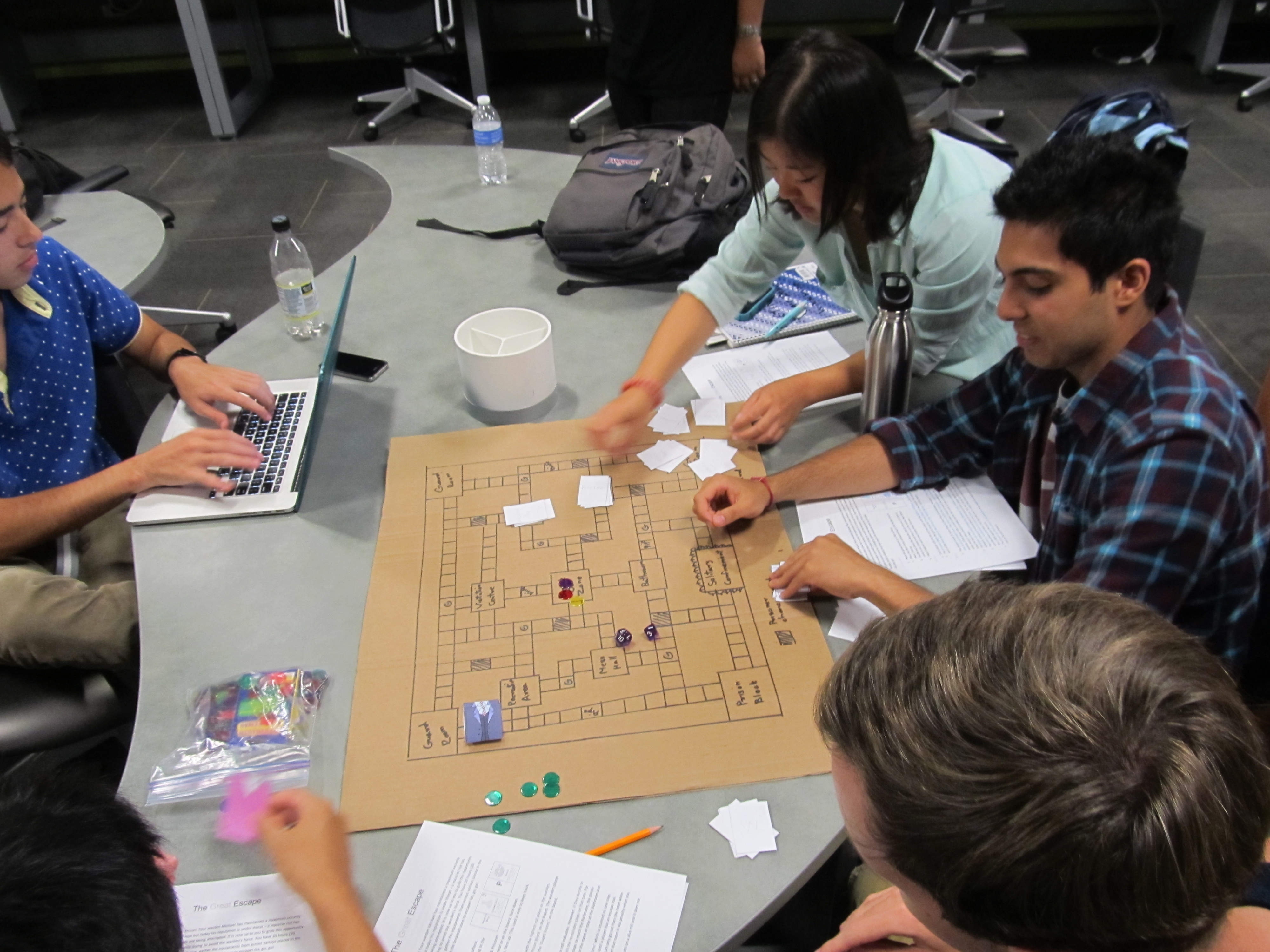
A four-player, asymmetrical stealth/strategy game. Three players cooperate to gather needed equipment to make a daring escape from the prison while The Warden commands around Guards to thwart their escape. Not a bad start to the semester.
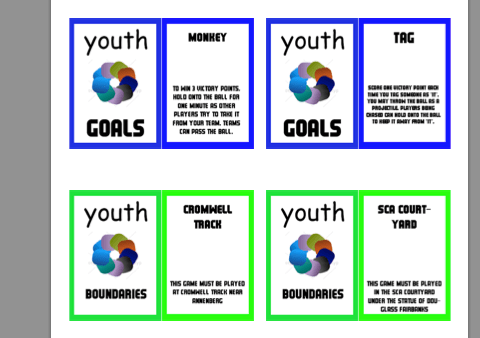
A card-based system for procedurally generating various nondigital games. A metaphor for the progression of life akin to Jason Roherer’s Passage or thatgamecompany’s Journey. A tad overambitious for a very short sprint, but one of the more interesting projects I’ve done.
Codesigned with McKenzie Carlile, Alan Hung, and Kristen Louie.
A minimalistic, nonviolent strategy game revolving around tactical moving and blocking. Sugarcube underwent radical revisions during its lifetime, evolving from a theater/improv game called Assassin’s Feed into its current iteration as a simple but deep movement game.
Codesigned with Jake Balentine, Alan Hung, and Aditya Valvi.
An asymmetrical survival-horror game for eight players. Six players play as human scientists, who must gather materials to escape the facility. One player plays the Android, who disguises himself as a human and subverts the human escape plan. The last player is the Creature, and must stalk and kill all the humans. Features suspenseful gameplay and legitimately scary mechanics.
After accidentally deleting all my notes and getting really frustrated, I finally completed part 2 of my personal favorite games of the 7th Console Generation, the first of which you can read here. Sparing the need for a lengthy introduction, let’s get right to it.
6. Okami
Okami holds the dubious honor of being the worst-selling recipient of a “Game of the Year” accolade from a major gaming publication. Which is pitiful, because Okami is a wonderful and uplifting adventure of mythical scope and legendary beauty. Thick outlines, wispy details, and a rich palette lend the game a painterly aesthetic inspired by traditional sumi-e watercolor painting. The vast world of Nippon provides an incredible possibility space for any number of adventures, each quest draws players into a fairytale world where friendly deities inhabit everyday life, helping humans with their everyday problems and protecting them from nasty demons like Blight, Ninetales, and Crimson Helm. Okami isn’t a dark, serious, conflict between forces of good and evil, but rather a playful, childlike one, with animals to feed, forests to regrow, and bridges to repair.
Okami was special because it imbued action-adventure mechanics with positivity and love.
An innovative core mechanic provides players with a thematically assonant means to interact with the delightful world. Using the Celestial Brush, controlled with the Wii Remote, players can paint objects into existence: a swish of the brush produces a strong gust, while a circle in the sky produces bright sunlight. Using a collection of brush techniques, players enact positive change upon the world. Carrying a positive subtext about environmental preservation and restoration, Okami‘s methods of interaction revolve around construction and restoration, rather than killing and destruction, making it ultimately way more unique as an action-adventure game than it should be. Enemies don’t fall over and die, but burst into beautiful clouds of flowers and butterflies, suggesting that the act of killing a creature is an action of liberation and restoration, rather than strictly one of violence. This all culminates to create a sense of mythic wonder characteristic of the very best of adventures.
5. Bastion
Bastion is a textbook example of how to design a linear game of progression properly. An isometric hack-‘n-slash game, Bastion delivers its story in a unique way, a reactive narrator, Rucks, voiced by the cool, wistful, Logan Cunningham, comments on every action the player takes, delivering a constant stream of exposition that lends the narrative a detached, forlorn feel. In Bastion, the player wakes up to find his home world of Cylondia destroyed by some cataclysm of unknown origin, known only as the Calamity. He meets Rucks, and the two work together to collect crystals to restore power to the Bastion, a floating ship that would either allow them to set sail away from post-apocalytpic Cylondia or send them back through time to Cylondia before the Cataclysm.
Bastion was special because it was aesthetically luscious and perfectly paced.
Metaphorically, Bastion is an allegory about failed relationships. Players can choose to accept that great loss and move on, hoping to come across new friends, memories, and love somewhere in a terrifyingly vast future. Or they may choose to cling on to the possibility of reliving those moments of joy and returning to peaceful life prior to the Calamity, all while living in the shadow of the possibility that the Calamity would happen again. Its an emotive story with impactful, real-world implications.
Outside of its luscious, painterly aesthetic, its twangy, evocative soundtrack, and its original narrative, Bastion is perfectly paced and filled with variety. Every weapon the player acquires fundamentally changes how the game works. Different pieces of equipment don’t alter the numbers soft coded into the game’s combat system, but introduce systemic changes that substantially alter kinesthetics, tactics, and combat encounters. Playing Bastion with a machete and a bow is fundamentally different from playing Bastion with a shotgun and mortar, creating such an incredible degree of dynamism that players could have radically different experiences playing through the same story.
4. Super Mario Galaxy
Gravity isn’t our friend in video games, its shadow creeps behind our every move in space like an overbearing schoolteacher, eagerly seeking out the slightest fault. Hungrily it waits, waiting for the opportunity to end our fun, bringing us careening down into the lava pit, the bottomless abyss, the steel bed of spikes. Jumping may grant us temporary liberation from its heavy grip, but down we fall, unable to escape its gloomy grasp. No matter how joyful and free we may believe ourselves to be, Gravity’s inescapable shadow paces restlessly, watching us, reminding us that we are mortal, and that our fun comes at a risk.
Super Mario Galaxy was special because it recreated gaming’s oldest adversary as a playful friend.
Which is why Super Mario Galaxy is perhaps the greatest 3D platformer of this generation. Here, gravity is not judge nor adversary, but friend, playfully inviting us to dance. Levels in Super Mario Galaxy are comprised of numerous objects in space, each with its own gravity field. Gravity in Galaxy becomes a toy to be played with, and players joyfully dance through planetoid, starfield, and asteroid as they experiment with the boundaries of this otherworldly conception of physics. Suddenly, movement through virtual space, an experience that we’ve long since become accustomed to that it has become rote, becomes fresh, joyful, liberating. The cathartic escape of spinning into that first launch star and rocketing myself away from my preconceptions about physics is a feeling that I will never forget.
3. The Last of Us
Most AAA action-games ask players to enact power-fantasies, granting players a plethora of skills, powers, weapons, and tools, and giving them a stream of opponents and challenges to unleash them upon. Skillful play in games like Batman and Vanquish is empowering, the aggressive thrill of terrorizing violent thugs and evil robots intoxicating.This power fantasy has become so deeply encoded into video games that it has become the unsurprising norm. In direct contrast is The Last of Us, Naughty Dog’s post apocalyptic survival-horror myth, where combat is explicitly disempowering.
A hybrid of mechanics lifted from third-person shooters and stealth games, every combat encounter in The Last of Us overwhelms players with a tapestry of emotions, fear, panic, and catharsis. Interspersed between battles are long swaths of scavenging and exploration through believably designed environments, all performed in the creeping shadow of the possibility of ambush. Little glimmers of hope pierce the bleakness, often in the form of small portions of essential resources: half a bottle of alcohol, a broken pair of scissors, a cup of sugar. But desperately they may scavenge, players are never quite adequately prepared for any given encounter. Enemies are typically overwhelmingly strong, and almost always greatly outnumber Ellie and Joel. Their smart, hunter-ly behavior pigeonholes players into moving conservatively around the environment, the dreadfully tense dance between covers crescendoes into a panicked ratchet of gunfire and shivs, climaxing with the cathartic release of killing that last thug or Clicker. And then, the grisly and nauseating aftermath, the sigh of relief transitions back into anxiety, and the heavy shadow of desperation creeps on.
The Last of Us was special because its mechanics textured its powerful narrative elegantly.
And that’s to speak only of the game’s mechanics. The Last of Us remyths the archetypical “zombie” narrative in one of of the most engaging stories of that kind in recent memory, exploring themes about the demarcation of social boundaries of what entails “us” and “them” and what constitutes people as being “the other”. Restrained, tasteful cinematography and animation communicates unspoken, repressed, emotions, Ellie and Joel’s character development is represented cinematically with nuanced grace. The game’s incredible ending meditates on the moral intricacies of Christianity’s central narrative, arriving at an uneasy conclusion about interdependency and need. The Last of Us‘s mechanics, intricately designed to be assonant with the world and narrative, create a cohesive whole that is indubitably one of the best games of the year.
2. Portal 2
Portal 2 is the apotheosis of trial-and-error design, it is the greatest puzzle game ever made, and a great leap forward in environmental storytelling. Every single Test Chamber in the game is intricately designed, carefully introducing new mechanics, iterating upon them, and exploring new, creative ways to use them in its relatively limited possibility space. An incredibly simple and intuitive core mechanic becomes a portal into an ever expanding toolbox of light-bridges, gravity tubes, and repulsion gels. In any other game, the core loop of trial-and-error would have been immensely frustrating, the exasperation of repeated failures creates an incredibly negative experience greatly detracting from a game’s appeal. Portal 2 refines that core loop into something more akin to scientific experimentation: theorize, test, fail, theorize, test, fail, theorize, test, succeed. With each failed attempt at solving a puzzle, players discover more and more about Portal 2‘s conception of 3D space, and the constant acquisition of mastery becomes increasingly palpable. What is even more remarkable is Portal 2 achieves such depth and complexity without introducing a single additional control
Portal 2 was special because it exemplified great puzzle-design.
Representationally, Portal 2 is one of the more interesting advancements in environmental storytelling. The sterile hallways and elevators of the first Portal crack at the seams, giving way to lush vegetation and unspoken post apocalyptic ruin. The nostalgic design of Old Aperture conveys an authentic sense of style and place, communicating Cave Johnson’s character arc as he led Aperture through decades of decline. While the core narrative of trust, betrayal, and tenuous partnership has been done before in other games, Portal 2‘s genuinely funny writing and lovably sadistic characters allow it to transcend its cliches, turning it into one of the most original adventures of the last few years.
1. Journey
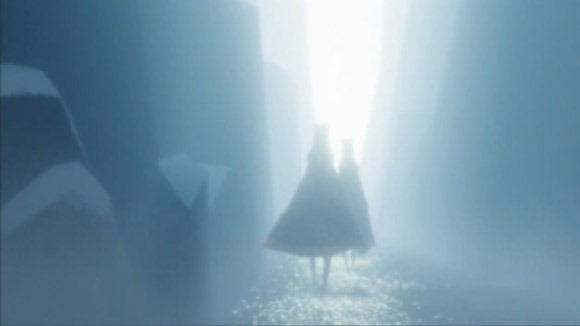
As I climbed over that first dune in the desert, I saw the mountain towering before me, eclipsing the sun’s blinding glow. The sands stretched out infinitely, the murky haze of warm air obscured my vision, and I couldn’t perceive the crevasses, towers, and valleys that laid in the wide expanse of my future. I slid down the slope, walking towards the first shrine I saw, and found a glowing insignia floating before an altar. I touched it, and a red, glowing scarf materialized out of thin air and wrapped itself around my neck. I jumped off the shrine, and gently floated, weightless, liberated and free. The scarf granted me the power of limited flight. I smiled, and hopped my first steps towards the vast monolith in the horizon. As I walked, my vision of the mountain gradually became clearer and more distinct, and I knew that I was destined to ascend it.
On my way, I met other people, also on their way towards whatever destination they were seeking. Some accompanied me, happily chirping as we hiked the desert sands, others looked away and hurried along the stony ridges. I met another cloaked traveler in the collapsed ruins of a city who decided to accompany me, a gleeful chirp and a dainty dance sealed our partnership. We ascended climbed the temple of our ancestors to arrive at a snow-covered slope. We were very close to the summit, the mountain’s peak visible behind a thin layer of clouds, and so we pushed on. As we climbed the snow-blanketed slopes, the wind began to blow. A thin layer of frost formed around my scarf and cracked away at it. We pushed on, and the wind blew angrily, pushing us backwards like an invisible force opposing us, and more of the scarf crumbled away. The wind matured into a blizzard, ice battered our bodies, freezing our cloaks. We drew close together, hoping the warmth of each other’s bodies would sustain the magic scarves until we reached the top, but gusts of snow would throw us apart. The stone dragons hungrily floated above us, waiting to strike at us in our weakness. We were tired, worn, and weary, and our strong stride slowed to a desperate crawl, each step more arduous than the last. The clouds above us congealed into a solid grey firmament, and the mountain’s peak faded away. I looked at my partner, and his head bobbed feebly as it if it was trying to make a sound, but only managed a weak moan, and crumbled into the snow, dead. Terrified, I tried to call back, but the flow of cold air into my lungs crushed me, and I collapsed onto the slope, I looked up, trying to make out the peak, but couldn’t, and died.
And I was basked by a welcome glow and a pleasant warmth. I opened my eyes, and saw my ancestors standing before me. They pulled my broken body from the ice, and gave me a new magic scarf and stepped away from me. An electrifying chill of power pulsed through my body, and I leapt skyward, through the storm layer and past the stone dragons. I pierced the cloud layer and I arrived at the summit. The sky was clear, and the warm sun cast a gentle glow upon the heavenly cloth bridges and red gates. I playfully danced across the bridges, down a slope, and over waterfalls of crashing mist, arriving at a beam of glowing dust. I flew into it and floated towards the peak, and there, my partner was waiting. A bright light and a soft breeze emitted from a great crack in the mountains peak, blowing a thin layer of snow past our feet. Our scarves crumbled away, and we walked towards the light. As we stepped into the blinding whiteness of our ultimate destiny, my partner chirped happily at me, as if to say “thank you”.
Catharsis, plain and simple.
And then Journey ended, and I sat before my television. I gripped my controller harder.
Thoughts of the life that I had lived flooded into my consciousness. The teachers that I’ve had, the friends who have loved me, and the wise family that had watched over me and lovingly watched me step forward into every stage of my life. I thought of the bridges I had burned, the relationships that I had nuked, the lies that I’ve believed, and the ways I’ve hurt and hurt-ed. I thought of the path that I chose to arrive where I was, and my nascent purpose. Then I thought about my irreversible choice to live the life of a game designer. Journey was a game that had affected me unlike any other, touching me spiritually and giving me an cherishable experience. This is the power of video games! This is what I can potentially accomplish should I take this path! This is the kind of experience I could give to my players! This is what I want to do with my brief journey through the wilderness of life!
I received a letter the very next week. It was an acceptance letter from a college that I wanted to go to: the USC Interactive Media Division, the most renowned game school in the world and the very same program from which Journey’s creators graduated. I nodded knowingly, accepting my destiny, and took those first steps towards that mountain looming on the horizon, ready to accept the company of any strangers I would meet along the way.






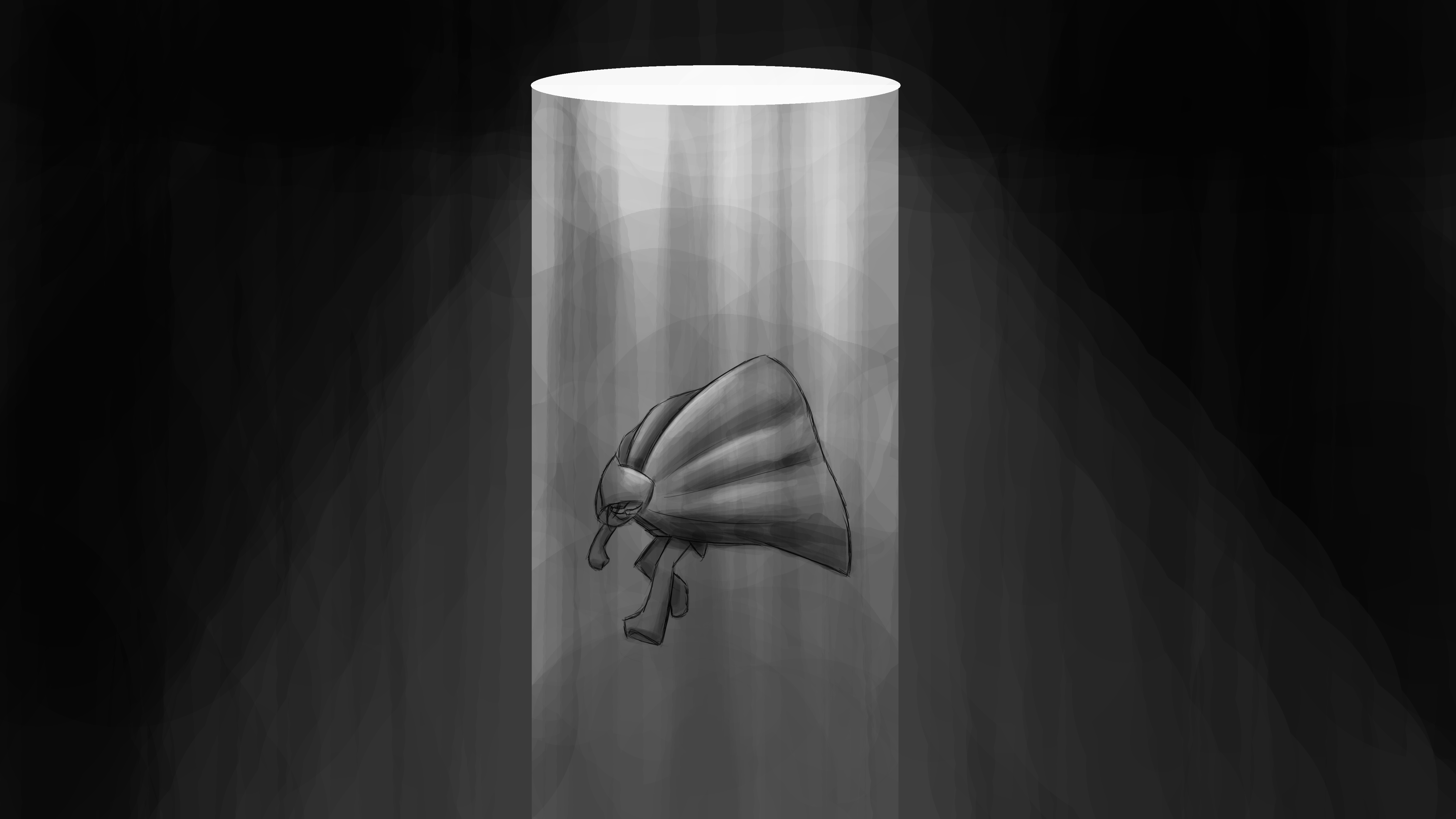
![An introspective,` intentionally-frustrating platformer about purpose and destiny. [designer]](https://thatkevinwong.com/wp-content/uploads/2012/11/screenshot-2014-04-20-12-13-52.png)











 KEVIN JAMES WONG